
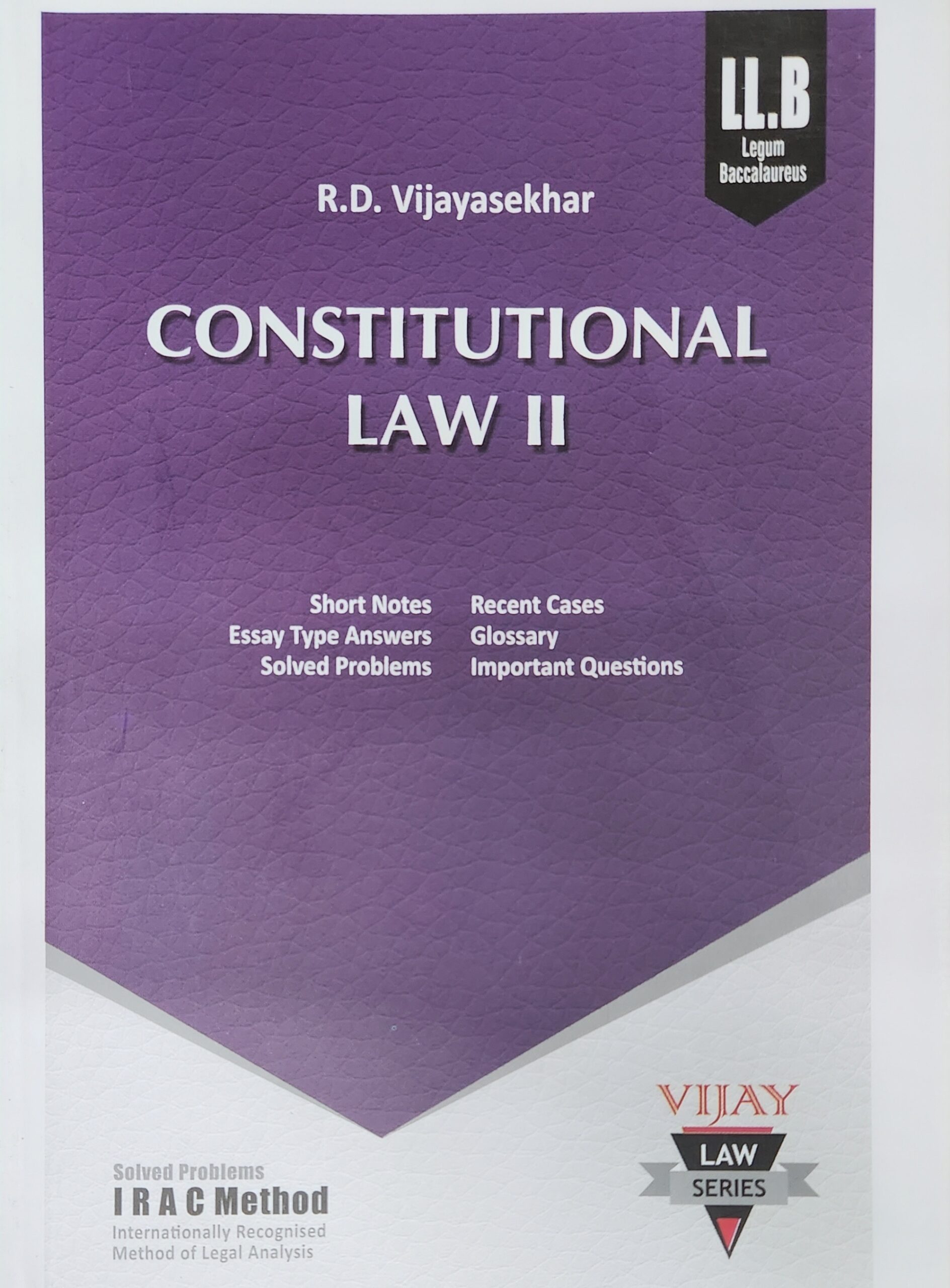
BUY CONSTITUTIONAL LAW II | VIJAY LAW SERIES | BEST GUIDE | BEST GUIDE FOR BL LLB STUDENTS |
………………………………………………………………………………..
Description
Constitutional law is the body of law which defines the relationship of different entities within a state, namely, the executive, the legislature, and the judiciary.
It lays down the framework defining fundamental political principles, establishes the structure, procedures, powers, and duties of government institutions, and sets out fundamental rights, directive principles, and the duties of citizens.
A good understanding of the Constitution and the law, which has developed through constitutional amendments, judicial decisions, constitutional practice and conventions is, therefore, absolutely necessary for a student of law.
Constitutional law is a body of law which defines the role, powers, and structure of different entities within a state, namely, the executive, the parliament or legislature, and the judiciary; as well as the basic rights of citizens and their relationship with their governments, and in federal countries such as the United States and Canada, the relationship between the central government and state, provincial, or territorial governments.
The Supreme Court has played a crucial role in interpreting the Constitution. Study of Constitutional Law focuses heavily on Supreme Court rulings. Constitutional Law – II begins with the concept of federalism, and continues form Article 52 of the Constitution. The student of law must also know the genesis, nature and special features and be aware of the social, political and economic influence on the Constitution.
A student must, learn how various interpretations of the constitution are possible in a particular situation. Such a critical approach is necessary requirement in the study of constitutional law.
……………………………………………………………………………..
Contents
Chapter 1 : Federal System
Chapter 2 : Parliament
Chapter 3 : State Executive
Chapter 4 : Judiciary
Chapter 5 : Centre-State Relations
Chapter 6 : Special Status to Jammu and Kashmir
Chapter 7 : Legislative Privileges
Chapter 8 : State Liability
Chapter 9 : Trade, Commerce and Intercourse in India
Chapter 10 : Services under the Union and the States
Chapter 11 : Emergency Provisions
Chapter 12 : Amendment Provisions
Chapter 13 : Constitutional Provisions Relating to PIL
Chapter 14 : Landmark Judgment
Appendices
Short Notes Index
Short Notes
Dictionary
Frequently Asked Questions
Model Question paper
Reference Books
Subject Index
ALSO

Reviews
There are no reviews yet.