
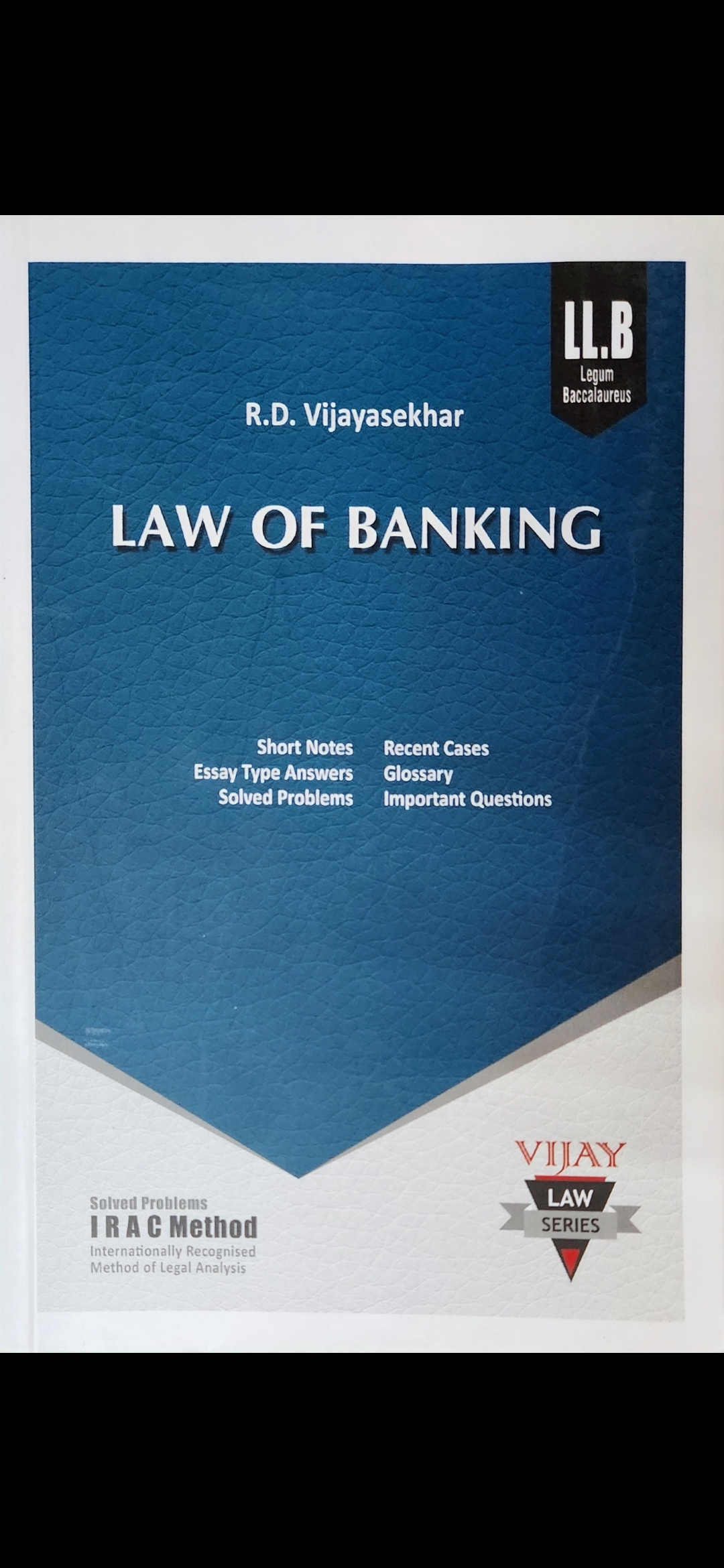
BUY LAW OF BANKING | VIJAY LAW SERIES | BEST GUIDE FOR LLB STUDENTS | 2025|
Description
Banking law is not a separate area of law like contract or torts. It is described as the collection of legal principles which regulates the banking transactions and also the banker- customer relationship.
Thus banking law is a wide-ranging and constantly changing area of the law.It focuses on an activity which has been at the heart of a strong economy since ancient times and which intersects with the lives of most individuals anyone with a bank account.
It is a challenging, interesting and important body of knowledge for a student of law.The history of banking law in India is based on the English Banking Law.
On the recommendations of the Hilton Young Commission, the Reserve Bank of India Act, 1934 was passed. It provides the statutory basis of the functioning of the Bank.
In the early 1990s, the then Government embarked on a policy of liberalisation, licensing a small number of private banks.
The services banks render to the general public do have a significant contribution to the development of the economy.
The process of the working of the banks and the legal control over them as well as the protection to the consumers of banking services are areas which a student of law is necessarily familiar with.
The Banking Regulation Act, 1949 is a law in India that regulates all banking companies in India.[1] Passed as the Banking Companies Act 1949, it came into force on 16 March 1949 and changed to Banking Regulation Act 1949 from 1 March 1966. It is applicable in Jammu and Kashmir from 1956. Initially, the law was applicable only to banking companies. But, in 1965 it was amended to make it applicable to cooperative banks and to introduce other changes.In 2020 it was amended to bring the cooperative banks under the supervision of the Reserve Bank of India (RBI).
ALSO ,


Reviews
There are no reviews yet.