
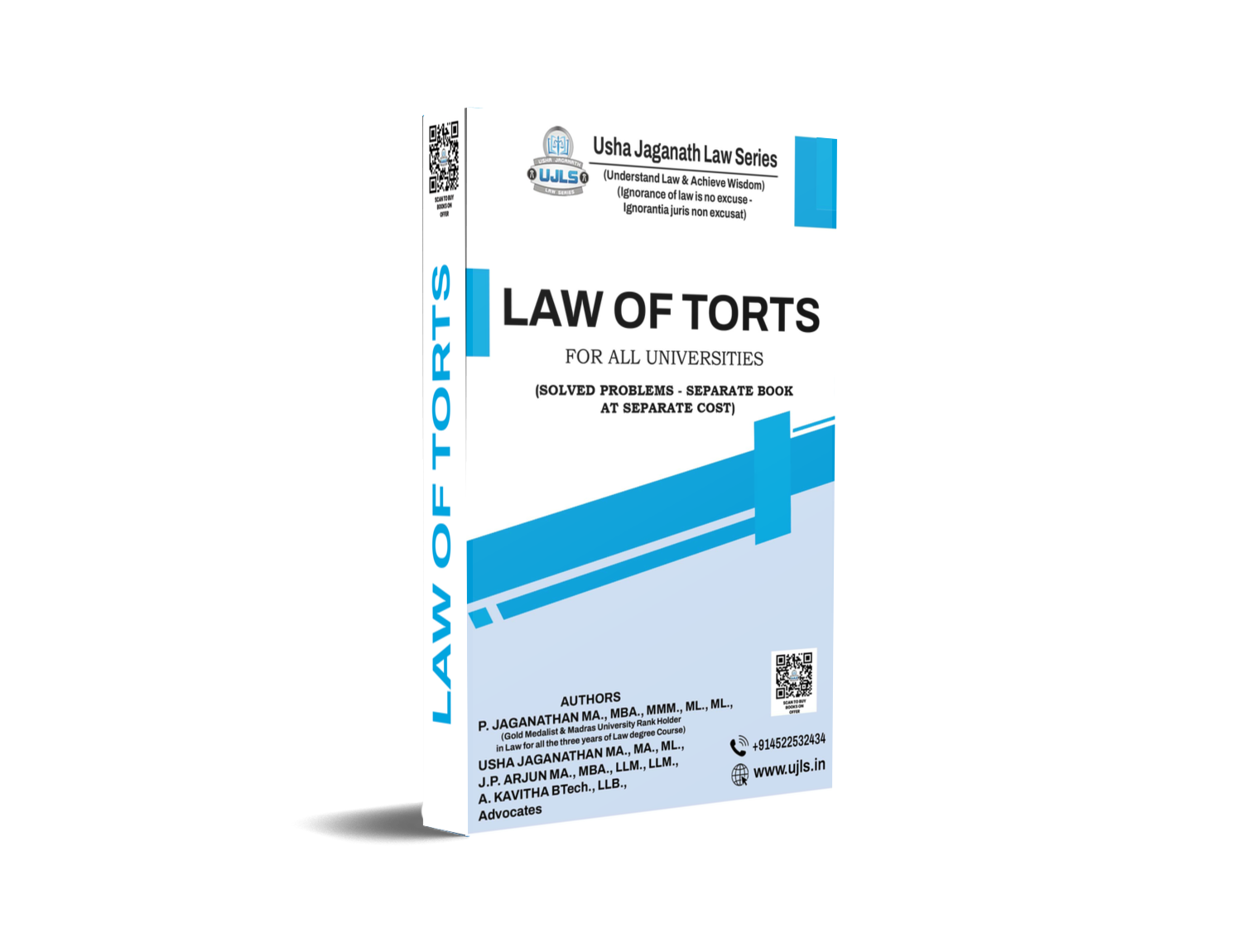
BUY LAW OF TORTS USHA | USHA JAGANATHAN LAW SERIES GUIDE | ALL UNIVERSITIES | BEST QUALITY | 1st EDITION |
The Law Of Torts, Unlike The Other Statutory Laws, Is Mainly Based On Case Laws. The Indian Law Of Torts Is Primarily Based On English Case Laws. The Study Of This Subject Is Becoming Increasingly Important With The Complexities Of Modern Life, And The Law Is Growing Fast Leading To Higher Evolution And Grouping Of New Torts Like Fault Theory, Economic Tort, Doubtful Tort, Changes In The Doctrine Of Absolute Liability, Etc., Since Case Laws Are The Foundation Of The Study Of This Subject, Every Effort Has Been Taken To Incorporate As Many Important Case Laws As Possible With A View To Clearly Elucidate The Legal Principles.
The Legal Maxims And Their Meaning And The Answers For The Previous Year University Questions Will Help To Understand And Review The Subject Thoroughly. This Book Has Already Evoked Overwhelming Response From The Student Community By Sales Of Over One Lakh Copies And It Is Hoped That This Revised Edition Will Receive The Same Overwhelming Support As Of Earlier Editions.
A tort is a civil wrong, other than breach of contract, that causes a claimant to suffer loss or harm, resulting in legal liability for the person who commits the tortious act.[1] Tort law can be contrasted with criminal law, which deals with criminal wrongs that are punishable by the state. While criminal law aims to punish individuals who commit crimes, tort law aims to compensate individuals who suffer harm as a result of the actions of others.[2][a]
Some wrongful acts, such as assault and battery, can result in both a civil lawsuit and a criminal prosecution in countries where the civil and criminal legal systems are separate. Tort law may also be contrasted with contract law, which provides civil remedies after breach of a duty that arises from a contract. Obligations in both tort and criminal law are more fundamental and are imposed regardless of whether the parties have a contract.
While tort law in civil law jurisdictions largely derives from Roman law, common law jurisdictions derive their tort law from customary English tort law. In civil law jurisdictions based on civil codes, both contractual and tortious or delictual liability is typically outlined in a civil code based on Roman Law principles.
ort law is referred to as the law of delict in Scots and Roman Dutch law, and resembles tort law in common law jurisdictions in that rules regarding civil liability are established primarily by precedent and theory rather than an exhaustive code. However, like other civil law jurisdictions, the underlying principles are drawn from Roman law. A handful of jurisdictions have codified a mixture of common and civil law jurisprudence either due to their colonial past (e.g. Québec, St Lucia, Mauritius) or due to influence from multiple legal traditions when their civil codes were drafted (e.g. Mainland China, the Philippines, and Thailand). Furthermore, Israel essentially codifies common law provisions on tort.
BUY LAW OF TORTS USHA | USHA JAGANATHAN LAW SERIES GUIDE | ALL UNIVERSITIES | BEST QUALITY | 1st EDITION |
Overview
In common, civil, and mixed law jurisdictions alike, the main remedy available to plaintiffs under tort law is compensation in damages, or money. Further, in the case of a continuing tort, or even where harm is merely threatened, the courts will sometimes grant an injunction, such as in the English case of Miller v Jackson. Usually injunctions will not impose positive obligations on tortfeasors, but some jurisdictions, such as those in Australia, can make an order for specific performance to ensure that the defendant carries out certain legal obligations, especially in relation to nuisance matters.
At the same time, each legal system provides for a variety of defences for defendants in tort claims which, partially or fully, shield defendants from liability. In a limited range of cases varying between jurisdictions, tort law will tolerate self-help as an appropriate remedy for certain torts. One example of this is the toleration of the use of reasonable force to expel a trespasser, which is typically also a defence against the tort of battery.
In some, but not all, civil and mixed law jurisdictions, the term delict is used to refer to this category of civil wrong, though it can also refer to criminal offences. Other jurisdictions may use terms such as extracontractual responsibility (France) or civil responsibility (Québec).
In comparative law, the term tort is generally used.[b] The word ‘tort’ was first used in a legal context in the 1580s,[c] although different words were used for similar concepts prior to this time. A person who commits a tortious act is called a tortfeasor. Although crimes may be torts, the cause of legal action in civil torts is not necessarily the result of criminal action. A victim of harm, commonly called the injured party or plaintiff, can recover their losses as damages in a lawsuit. To prevail, the plaintiff in the lawsuit must generally show that the tortfeasor’s actions or lack of action was the proximate cause of the harm, though the specific requirements vary between jurisdictions.
BUY LAW OF TORTS USHA | USHA JAGANATHAN LAW SERIES GUIDE | ALL UNIVERSITIES | BEST QUALITY | 1st EDITION |
Aslo Buy
Reviews
There are no reviews yet.