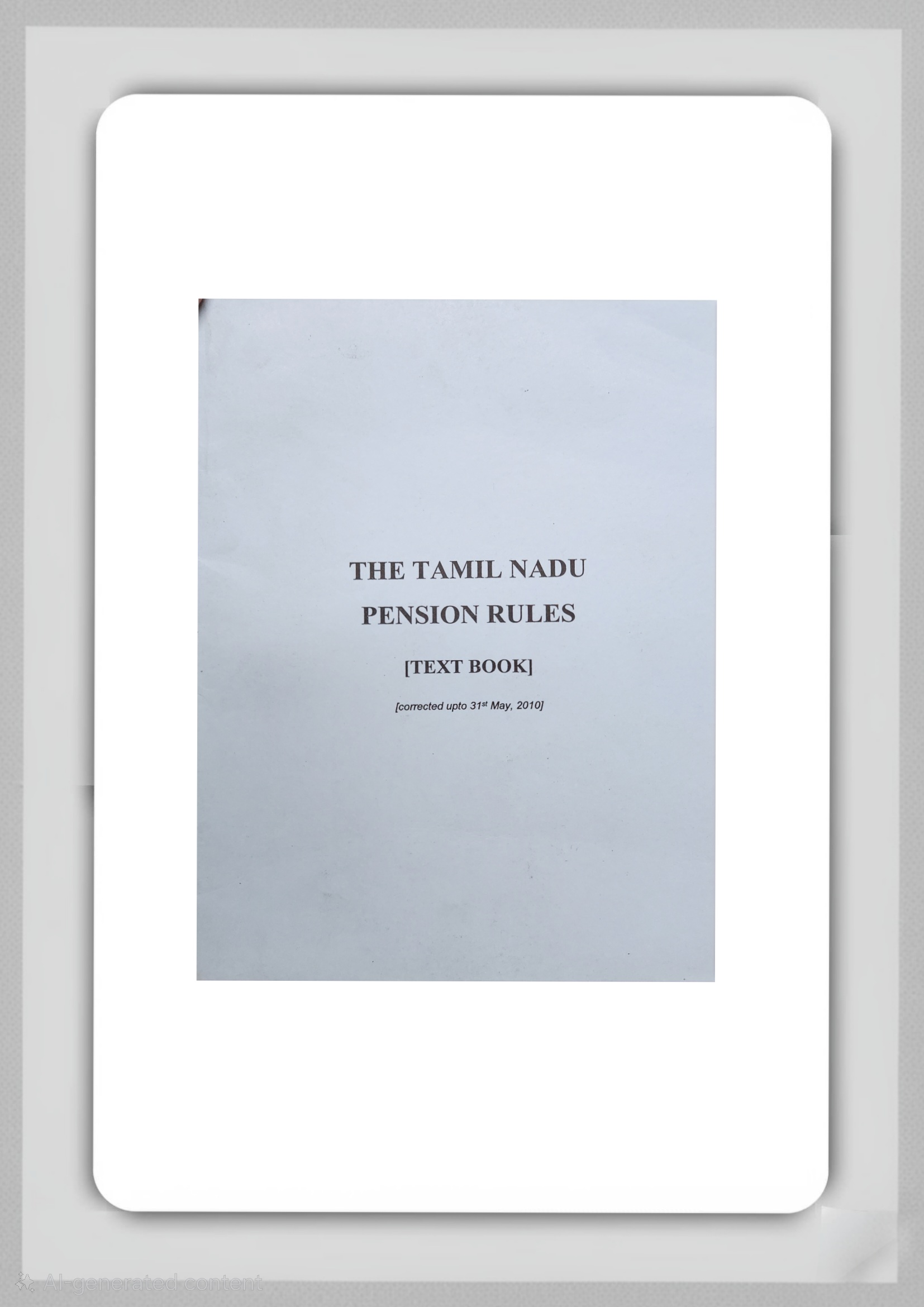
BUY THE TAMILNADU PENSION RULES HARIHARAN | ENGLISH | N A HARIHARAN | BEST GOVERNMENT DEPARTMENTAL EXAM BOOK | BEST BOOK FOR GOVERNMENT PROMOTION EXAM | SAMIROO PUBLISHERS |
THE TAMILNADU PENSION RULES HARIHARAN
(1)These rules may be called the Tamil Nadu Pension Rules, 1978.
(2)They shall be deemed to have come into force on the 1st January 1979.
2. Application.
– Save as otherwise provided in these rules, these Rules shall apply to all Government Servants appointed to Services and posts in connection with the affairs of the State which are borne on pensionable establishments, whether temporary or permanent, but shall not apply to –
(a)Persons in causal and daily rated employment;
(b)Persons paid from contingencies;
(c)Persons employed on contract expect when the contract provides otherwise;
(d)Members of the All-India Services;
(e)Persons entitled to the benefit of a Contributory Provident Fund;
(f)Persons who are entitled to the benefits under the Factories Act, 1948 and the Employees Provident Fund Act, 1952 excluding those who are governed by Statutory Service Rules and belong to pensionable service.
[Provided that these rules shall not apply to Government servants appointed on or after the 1st April 2003, to services and posts in connection with the affairs of the State which are borne on pensionable establishment, whether temporary or permanent.]
3. Definitions
THE TAMILNADU PENSION RULES HARIHARAN
–
(a)‘Audit Officer’ means the Accountant – General, Tamil Nadu, for service under the Tamil Nadu Government and the appropriate Audit Officer, for service under any other Government or body:
(b)‘Average Emoluments’ means average emoluments as determined in accordance with rule 31;
(c)‘Child’ means a child of a Government Servant who if a son, is under [21 years] 25 years of age and if a daughter is unmarried, and is under [24 years] [30 years] 25 years of age and the expression children shall be construed accordingly;
(cc)[ ‘Dearness Allowance’ means allowances as defined in rule 50-A;]
(d)‘Emoluments’ means emoluments as defined in rule 30;
(e)[ ‘Family Pension’ means ‘Family Pension, 1964’ admissible under rule 49 but does not include dearness allowance;]
(f)‘Foreign Service’ means service in which a Government servant receives his pay with the sanction of Government from any source other than the Consolidated Fund of India or Consolidated Fund of a State or the Consolidated Fund of a Union territory;
(g)‘Form’ means a Form appended to these rules;
(h)‘Government’ means the Government of Tamil Nadu;
(i)‘Gratuity’ includes-
(i)‘Service gratuity’ payable under sub-rule (1) of rule 43
(ii)‘Death- cum- retirement gratuity’ payable under sub-rule (I) of sub- rule (3) of rule 45; and
(j)‘Head of a Department’ means and include-
(i)Officers who have been declared by the Government to be Heads of Department;
(ii)Any other authority to which Government may delegate the powers of Head of a Department;
(k)‘Local Fund administered by Government’ means the fund administered by a body which by law or rule having the force of law, comes under the control of the Government and over whose expenditure the Government retain complete and direct control;
(l)‘minor’ means a person who has not completed the age of eighteen years;
(m)[ ‘pension’ includes gratuity except when the term pension is used in contradistinction to gratuity but does not include dearness allowance;]
(n)‘pension sanctioning authority’ means the authority competent to sanction pension under rule 55;
(o)‘qualifying service’ means permanent or officiating service (including temporary service under emergency provisions) rendered in a post included in a pensionable establishment;
(p)‘retirement benefits’ include pension or service gratuity and death-cum-retirement gratuity, where admissible;
(q)pension is said to be chargeable according to the ‘rule of proportions’ when the charge is debitable to several accounts in the proportions in which, the aggregated pay drawn by the officer during the whole of his qualifying service has been paid from them;
Note. – (i) Duty allowance and deputation (duty) allowance should be included in pay for the purpose of this rule.
(ii)If according to the rule of proportions the share of pension chargeable to one account does not exceed one rupee no charge shall be made to this account; and the share shall be borne by the account chargeable with the greatest share.
(r)‘Treasury’ includes a Sub-Treasury
(2)Words and expressions used herein and not defined but defined in the Fundamental Rules have the meanings respectively assigned to them in those rules.
BUY THE TAMILNADU PENSION RULES HARIHARAN | ENGLISH | N A HARIHARAN | BEST GOVERNMENT DEPARTMENTAL EXAM BOOK | BEST BOOK FOR GOVERNMENT PROMOTION EXAM | SAMIROO PUBLISHERS |
ALSO,

Reviews
There are no reviews yet.