
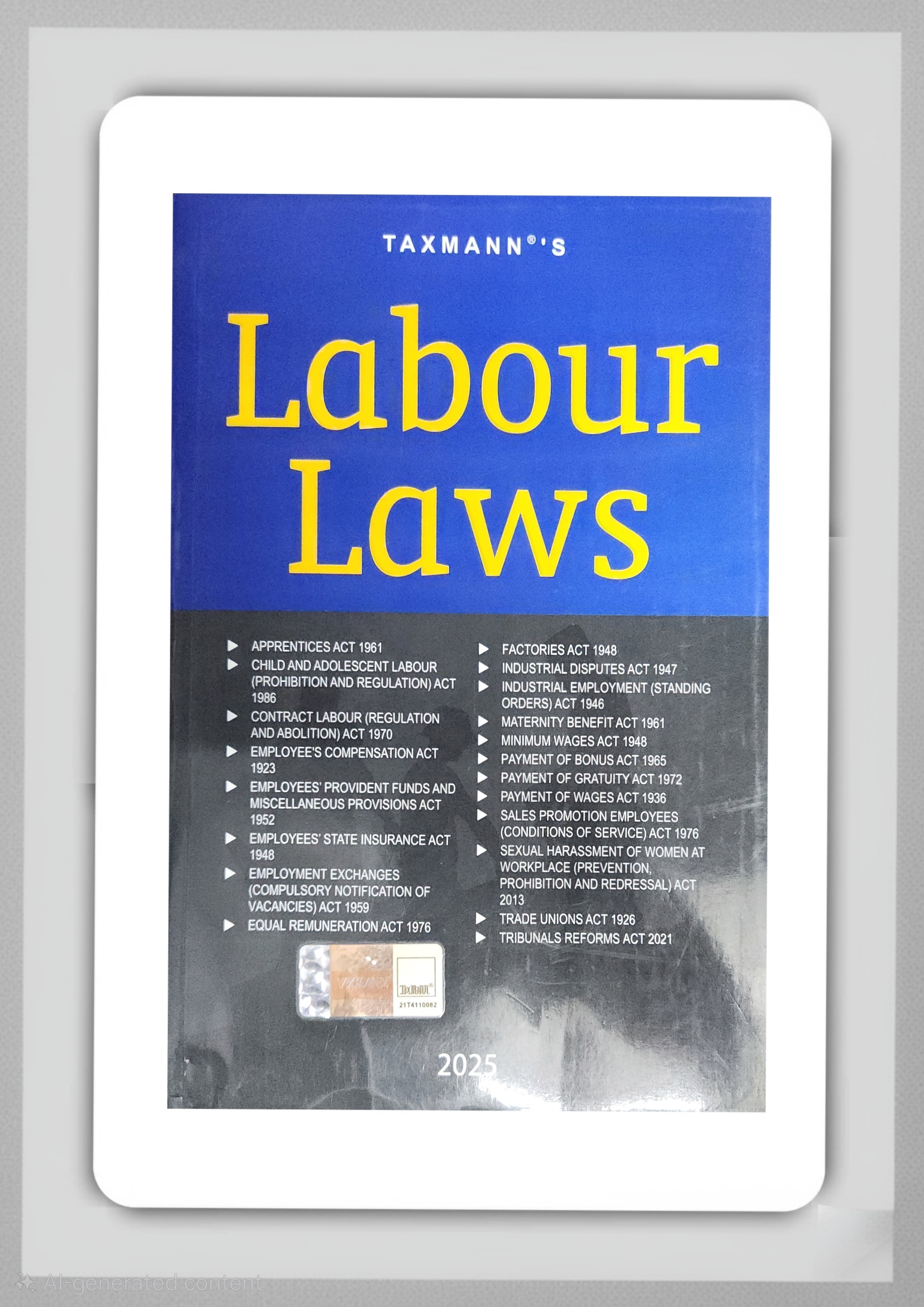
BUY LABOUR LAWS TAXMANN S |TAXMANN PUBLICATION | BEST PUBLICATION | 2025 |
This book provides complete coverage of India’s 20+ laws governing the following:
- Labour Laws
- Industrial Relations Laws, and
- Industrial Disputes
Along with the above, the readers also get a specially curated & 50+ pages’ Guide to Labour Laws’ to better understand the laws governing labour & industrial disputes.
The Present Publication is the 2023 Edition and amended up to 31st December 2022. This book is edited by Taxmann’s Editorial Board, with the following coverage:
- Apprentices Act, 1961
- Child and Adolescent Labour (Prohibition and Regulation) Act, 1986
- Contract Labour (Regulation and Abolition) Act, 1970
- Employee’s Compensation Act, 1923
- Employees’ Provident Funds and Miscellaneous Provisions Act, 1952
- Employees’ State Insurance Act, 1948
- Employment Exchanges (Compulsory Notification of Vacancies) Act, 1959
- Equal Remuneration Act, 1976*
- Factories Act, 1948
- Industrial Disputes Act, 1947
- Industrial Employment (Standing Orders) Act, 1946
- Industrial Tribunals
- Labour Laws (Simplification of Procedure for Furnishing Returns and Maintaining Registers by Certain Establishments) Act, 1988
- Maternity Benefit Act, 1961
- Minimum Wages Act, 1948*
- Payment of Bonus Act, 1965*
- Payment of Gratuity Act, 1972
- Payment of Wages Act, 1936*
- Sales Promotion Employees (Conditions of Service) Act, 1976
- Trade Unions Act, 1926
Labour laws (also spelled as labor laws), labour code or employment laws are those that mediate the relationship between workers, employing entities, trade unions, and the government. Collective labour law relates to the tripartite relationship between employee, employer, and union.
Individual labour law concerns employees’ rights at work also through the contract for work. Employment standards are social norms (in some cases also technical standards) for the minimum socially acceptable conditions under which employees or contractors are allowed to work. Government agencies (such as the former US Employment Standards Administration) enforce labour law (legislature, regulatory, or judicial).
History
Following the unification of the city-states in Assyria and Sumer by Sargon of Akkad into a single empire ruled from his home city circa 2334 BC, common Mesopotamian standards for length, area, volume, weight, and time used by artisan guilds in each city was promulgated by Naram-Sin of Akkad (c. 2254–2218 BC), Sargon’s grandson, including for shekels.[1] Code of Hammurabi Law 234 (c. 1755–1750 BC) stipulated a 2-shekel prevailing wage for each 60-gur (300-bushel) vessel constructed in an employment contract between a shipbuilder and a ship-owner.[2][3][4]
Law 275 stipulated a ferry rate of 3-gerah per day on a charterparty between a ship charterer and a shipmaster. Law 276 stipulated a 21⁄2-gerah per day freight rate on a contract of affreightment between a charterer and shipmaster, while Law 277 stipulated a 1⁄6-shekel per day freight rate for a 60-gur vessel.[5][6][4]
In 1816, an archeological excavation in Minya, Egypt (under an Eyalet of the Ottoman Empire) produced a Nerva–Antonine dynasty-era tablet from the ruins of the Temple of Antinous in Antinoöpolis, Aegyptus that prescribed the rules and membership dues of a burial society collegium established in Lanuvium, Italia in approximately 133 AD during the reign of Hadrian (117–138) of the Roman Empire.[7]
A collegium was any association in ancient Rome that acted as a legal entity. Following the passage of the Lex Julia during the reign of Julius Caesar as Consul and Dictator of the Roman Republic (49–44 BC), and their reaffirmation during the reign of Caesar Augustus as Princeps senatus and Imperator of the Roman Army (27 BC–14 AD), collegia required the approval of the Roman Senate or the Emperor in order to be authorized as legal bodies.[8] Ruins at Lambaesis date the formation of burial societies among Roman Army soldiers and Roman Navy mariners to the reign of Septimius Severus (193–211) in 198 AD.[9]
In September 2011, archeological investigations done at the site of the artificial harbour Portus in Rome revealed inscriptions in a shipyard constructed during the reign of Trajan (98–117) indicating the existence of a shipbuilders guild.[10] Rome’s La Ostia port was home to a guildhall for a corpus naviculariorum, a collegium of merchant mariners.[11] Collegium also included fraternities of Roman priests overseeing ritual sacrifices, practicing augury, keeping scriptures, arranging festivals, and maintaining specific religious cults.[12]
Labour law arose in parallel with the Industrial Revolution as the relationship between worker and employer changed from small-scale production studios to large-scale factories. Workers sought better conditions and the right to join a labour union, while employers sought a more predictable, flexible and less costly workforce. The state of labour law at any one time is therefore both the product of and a component of struggles between various social forces.
As England was the first country to industrialize, it was also the first to face the often appalling consequences of the industrial revolution in a less regulated economic framework. Over the course of the late 18th and early to the mid-19th century the foundation for modern labour law was slowly laid, However, in the early days, there were some unequal aspects, such as the target being limited to women and children and not adult men, as some of the more egregious aspects, of working conditions were steadily ameliorated through legislation. This was largely achieved through the concerted pressure from social reformers, notably Anthony Ashley-Cooper, 7th Earl of Shaftesbury, and others.
Also
BUY LABOUR AND INDUSTRIAL LAWS S N MISRA | CENTRAL LAW PUBLICATION | 30TH EDITION| BEST PUBLIACATION | 2024 |


Reviews
There are no reviews yet.