
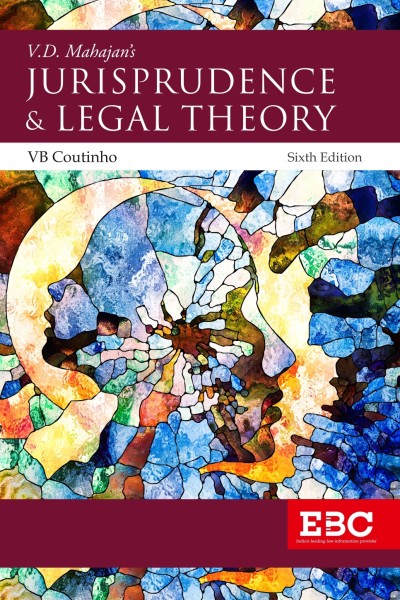
BUY JURISPRUDENCE AND LEGAL THEORY BY V D MAHAJAN | 2025 | 6TH EDITION | BEST PUBLICATION | EASTERN BOOK COMPANY EBC |
Justice K. Ramaswamy has described jurisprudence as “the eye of the law giving an insight into the environment of which it is the expression. It relates the law to the spirit of the time and makes it richer.” The study of jurisprudence started with the Romans.
The Latin equivalent of ” jurisprudence” is jurisprudential which means either “knowledge of the law” or “skill in law”. There has been a shift during the last century and jurisprudence today is envisaged in an immeasurably broader and more sweeping sense than that in which Austin understood it.
This new edition of V.D. Mahajan’s Jurisprudence dr Legal Theory has been accordingly revised, updated, and enlarged with a lot of Indian case law in order to offer the readers a broad perspective on the subject. This book is an excellent attempt to explain the legal concepts and the theories of law, including its sources, in simple and understandable language. The author has devoted separate chapters to all important topics, viz., nature & scope of jurisprudence, legislation, precedent, custom, legal rights and duties, ownership and possession, persons and liability, etc, and a new chapter on Feminist Movements.
An in-depth study has been made on the nature, scope, classification, and sources of law, including the concept of sovereignty and the administration of justice. An exhaustive index and suggested readings, given separately at the end of each chapter add to the utility of the book.
Reviews
The author has been successful in achieving his aim of providing an elementary book in simple and understandable language. Index and the suggested readings, given separately at the end of each chapter, for further material on the topics discussed, add to its utility and supply additional food for study and thought about law and legal science.
– Review Projector
There is a dearth of writing by Indian authors on jurisprudence and legal theory. V.D. Mahajan’s book makes a valuable contribution to filling up this gap. While discussing each theory the author has authenticated the subject with reference to all important writers and theoreticians on each of them. The wide-ranging references on each topic are valuable for any further study on the subject.
– Cochin University Law Review
This is a unique book in legal literature from which the students are able to get all the materials connected to this subject. Different references and discussions on various legal theories including international theories are provided. This book will be very useful to the students of law, the library of the colleges, lawyers, and all others who are connected to this subject.
– Gujarat Law Reporter
The author of the book possesses analytical knowledge of the subject and hence the book is complete with a full critical analysis of the subject containing various views of the distinguished jurists arranged under appropriate heads on all the basic concepts which underline systems of law. This edition benefits from the timely reappraisal of materials and their strict relevance to the subject. Undoubtedly, this book will be useful for ready reference to the students of law and practitioners alike. On the whole, the book is worth studying for a complete understanding of the subject and hence it deserves a rightful place in the library of law.
BUY JURISPRUDENCE AND LEGAL THEORY BY V D MAHAJAN | 2025 | 6TH EDITION | BEST PUBLICATION | EASTERN BOOK COMPANY EBC |
Jurisprudence, also known as theory of law or philosophy of law, is the examination in a general perspective of what law is and what it ought to be. It investigates issues such as the definition of law; legal validity; legal norms and values; and the relationship between law and other fields of study, including economics, ethics, history, sociology, and political philosophy.
Modern jurisprudence began in the 18th century and was based on the first principles of natural law, civil law, and the law of nations. Contemporary philosophy of law addresses problems internal to law and legal systems and problems of law as a social institution that relates to the larger political and social context in which it exists. Jurisprudence can be divided into categories both by the type of question scholars seek to answer and by the theories of jurisprudence, or schools of thought, regarding how those questions are best answered:
- Natural law holds that there are rational objective limits to the power of rulers, the foundations of law are accessible through reason, and it is from these laws of nature that human laws gain force.
- Analytic jurisprudence attempts to describe what law is. The two historically dominant theories in analytic jurisprudence are legal positivism and natural law theory. According to Legal Positivists, what law is and what law ought to be have no necessary connection to one another, so it is theoretically possible to engage in analytic jurisprudence without simultaneously engaging in normative jurisprudence. According to Natural Law Theorists, there is a necessary connection between what law is and what it ought to be, so it is impossible to engage in analytic jurisprudence without simultaneously engaging in normative jurisprudence.
- Normative jurisprudence attempts to prescribe what law ought to be. It is concerned with the goal or purpose of law and what moral or political theories provide a foundation for the law. It attempts to determine what the proper function of law should be, what sorts of acts should be subject to legal sanctions, and what sorts of punishment should be permitted.
- Sociological jurisprudence studies the nature and functions of law in the light of social scientific knowledge. It emphasises variation of legal phenomena between different cultures and societies. It relies especially on empirically-oriented social theory, but draws theoretical resources from diverse disciplines.
- Experimental jurisprudence seeks to investigate the content of legal concepts using the methods of social science, unlike the philosophical methods of traditional jurisprudence.
The terms “philosophy of law” and “jurisprudence” are often used interchangeably, though jurisprudence sometimes encompasses forms of reasoning that fit into economics or sociology.
Also buy



Reviews
There are no reviews yet.