
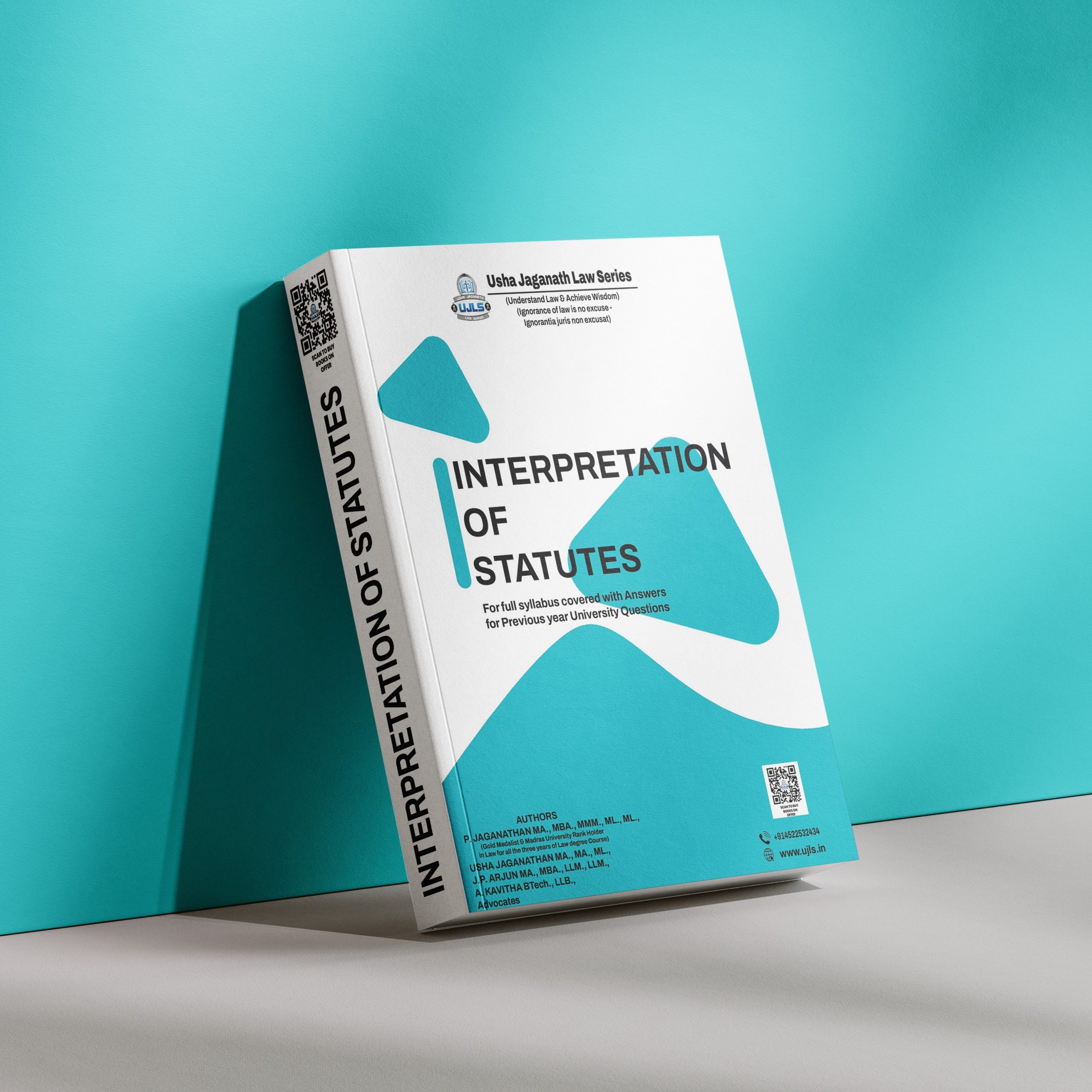
BUY INTERPRETATION OF STATUES USHA | USHA JAGANATHAN LAW SERIES GUIDE | ALL UNIVERSITY | BEST QUALITY | 1st EDITION |
Interpretation Of Statutes, As A Subject Of Study, Has Evolved From The Basic Substantive And Procedural Laws. Knowledge Of The Basic Laws Is An Essential Requirement For The Study Of Interpretation Of Statutes. Since It Is A Research-Oriented Subject, An In-Depth Study Is Necessary For Its Thorough Understanding.
Unfolding The Meaning Of Ambiguous Words And Expressions And Resolving Inconsistencies Through Interpretation And Construction Are The Main Objectives Of The Subject. The Established Rules Of Interpretations, The Judgments, The Views Of Jurists Etc., Are The Guidelines For Correct Interpretation Of The Words Used In Statutes. It Is, In This Context, The Author Has Taken Pains To Simplify The Rules Of Interpretation In Such A Way That Students Of Law Can Easily Understand, Assimilate, Remember And Present The Subject In The Examinations Coherently. The Subject Has Been Presented In The Form Of Essays With Sub Headings, Points And Model Questions For Every Chapter.
Short Notes, Case Laws And Legal Maxims Have Been Incorporated Separately And The Detailed Index Helps Students To Refer The Chapters And Short Notes Easily.Further, The Reference Answers For Previous Year University Questions Provided At The End Of The Book Will Be Extremely Useful For Review And For Examination Preparation.The Unique Presentation Of The Subject Matter Will Definitely Be Appreciated By The Student Community And It Is Hoped That This Book Will Be Of Immense Help For Their Examination Preparation And Also For Their Creditable Success In Examinations.
BUY INTERPRETATION OF STATUES USHA | USHA JAGANATHAN LAW SERIES GUIDE | ALL UNIVERSITY | BEST QUALITY | 1st EDITION |
Statutory interpretation is the process by which courts interpret and apply legislation. Some amount of interpretation is often necessary when a case involves a statute. Sometimes the words of a statute have a plain and a straightforward meaning, but in many cases, there is some ambiguity in the words of the statute that must be resolved by the judge. To find the meanings of statutes, judges use various tools and methods of statutory interpretation, including traditional canons of statutory interpretation, legislative history, and purpose. In common law jurisdictions, the judiciary may apply rules of statutory interpretation both to legislation enacted by the legislature and to delegated legislation such as administrative agency regulations.
BUY INTERPRETATION OF STATUES USHA | USHA JAGANATHAN LAW SERIES GUIDE | ALL UNIVERSITY | BEST QUALITY | 1st EDITION |
History
Statutory interpretation first became significant in common law systems, of which historically England is the exemplar. In Roman and civil law, a statute (or code) guides the magistrate, but there is no judicial precedent. In England, Parliament historically failed to enact a comprehensive code of legislation, which is why it was left to the courts to develop the common law; and having decided a case and given reasons for the decision, the decision would become binding on later courts.
Accordingly, a particular interpretation of a statute would also become binding, and it became necessary to introduce a consistent framework for statutory interpretation. In the construction (interpretation) of statutes, the principal aim of the court must be to carry out the “intention of Parliament”, and the English courts developed three main rules (plus some minor ones) to assist them in the task. These were: the mischief rule, the literal rule, and the golden rule.
BUY INTERPRETATION OF STATUES USHA | USHA JAGANATHAN LAW SERIES GUIDE | ALL UNIVERSITY | BEST QUALITY | 1st EDITION |
Also Buy,


Reviews
There are no reviews yet.