
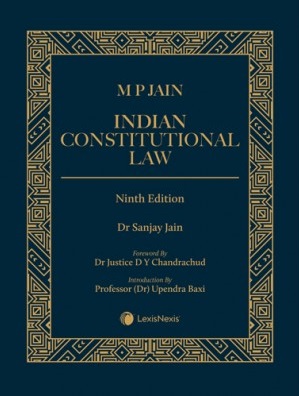
BUY INDIAN CONSTITUTIONAL LAW M P JAIN | 9TH Edition | LEXIS NEXIS | Best Text Book |
M P Jain’s Indian Constitutional Law is an authoritative and, classic treatise on Indian constitutional law. This book, presently in its Ninth edition, is a thematic presentation of the complex and multi-dimensional discipline of Indian Constitutional law in a lucid, comprehensive and systematic manner.
This edition delves into both the initial applications and modern interpretations of the Constitution of India. The book also takes note of the rich stream of contemporary jurisprudence with focus on areas like disability rights, intersectionality, and indirect discrimination, as well as evolving constitutional principles like Fiscal federalism, transformative constitutionalism and constitutional morality.
It is an important reference for the Bench and the Bar; students and teachers; public intellectuals and media folks; bureaucrats and Politicians; and social movement entrepreneurs alike.
Key Features:
- Thoroughly revised with the commentary on recent constitutional amendments and Supreme Court and High Court jurisprudence
- Analysis of doctrines like Transformative Constitutionalism, Constitutional Morality, Populist Constitutionalism, Constitutional silence, Unenumerated rights, Basic Structure, Accommodative Society, etc.
- Includes comprehensive commentary on concepts like privacy rights, abortion, and the right to be forgotten, criminalization of Triple Talaq, decolonization of criminal laws, relationship between the Central and State governments, Indirect discrimination, Intersectionality, Reasonable accommodation, Doctrine of Proportionality, etc
- In-depth and critical engagement with the impact of recent jurisprudence of Supreme Court in domains like electoral bond, Sub-classification amongst SC/ST, Modification of Article 370, Scope of Parliamentary privileges, Same Sex Marriage, Appointment of Election Commissioners, Royalty and Tax and Taxing powers of States, Scope of cultural and educational rights under Article 29-30, etc.
- Critical Reflections on contemporary scholarship in Indian Public Law and comparative Constitutional Law.
BUY INDIAN CONSTITUTIONAL LAW M P JAIN | 9TH Edition | LEXIS NEXIS | Best Text Book |
The Constitution of India is the supreme legal document of India, and the longest written national constitution in the world.[2][3][4][5] The document lays down the framework that demarcates fundamental political code, structure, procedures, powers, and duties of government institutions and sets out fundamental rights, directive principles, and the duties of citizens.
It espouses constitutional supremacy (not parliamentary supremacy found in the United Kingdom, since it was created by a constituent assembly rather than Parliament) and was adopted with a declaration in its preamble. Although the Indian Constitution does not contain a provision to limit the powers of the parliament to amend the constitution, the Supreme Court in Kesavananda Bharati v. State of Kerala held that there were certain features of the Indian constitution so integral to its functioning and existence that they could never be cut out of the constitution. This is known as the ‘Basic Structure’ Doctrine.
The Government of India Act 1935, mainly drafted by Samuel Hoare,[6] provided basis for the constitution of India. The constitution was adopted by the Constituent Assembly of India on 26 November 1949 and became effective on 26 January 1950.[7] It became the country’s fundamental governing document, and the Dominion of India became the Republic of India. To ensure constitutional autochthony, its framers repealed prior acts of the British parliament in Article 395.[8] India celebrates its constitution on 26 January as Republic Day.[9]
The constitution declares India a sovereign, socialist, secular,[10] and democratic republic, assures its citizens justice, equality, and liberty, and endeavours to promote fraternity.[11] The original 1950 constitution is preserved in a nitrogen-filled case at the Parliament Library Building in New Delhi.[12][13]
Background
In 1928, the All Parties Conference convened a committee in Lucknow to prepare the Constitution of India, which was known as the Nehru Report.
Also buy,
Reviews
There are no reviews yet.