
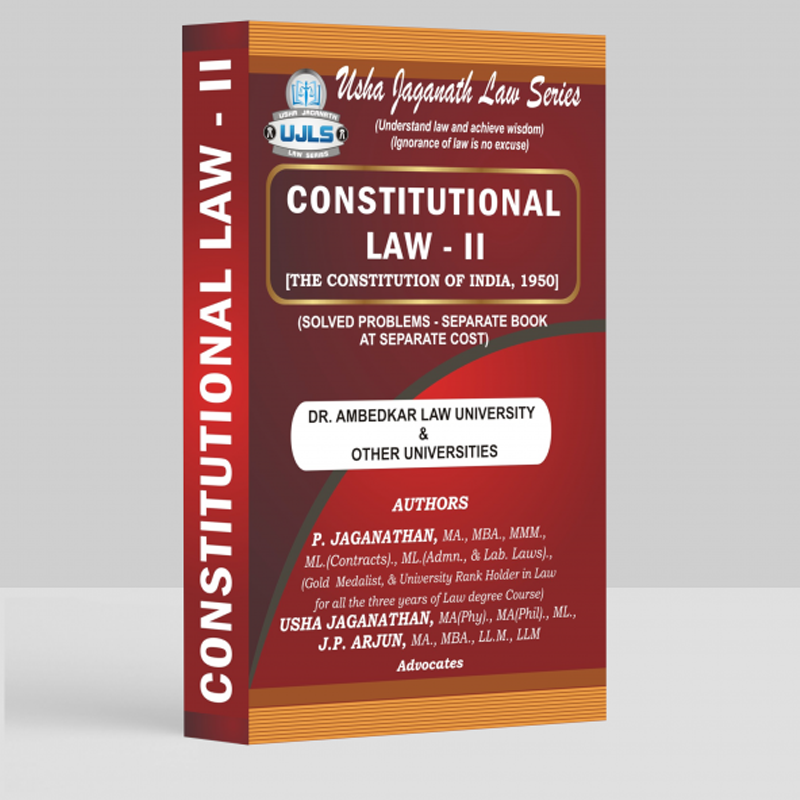
Buy INDIAN CONSTITUIONAL LAW II USHA | USHA JAGANATHAN LAW SERIES GUIDE | AMBEDKAR UNIVERSIY | BEST QUALITY | 1st EDITION |
The Indian Constitution, the largest and most detailed Constitution in the world, is significant for many of its outstanding features, which uniquely distinguish it from other Constitutions in the world. To quote Dr. Ambedkar, the framer of the Indian Constitution, “The Indian Constitution is tailor made to accommodate the peculiar needs of India”. The Indian Constitution, being the source and basis for all other legal enactments of the country not only for effective administration, but also for the successful functioning of an independent judiciary, needs to be thoroughly studied and mastered.
Now the subject ‘The Indian Constitution’ has been divided into two – “Constitution – I” and “Constitution – II” by Dr. Ambedkar Law University and Other Law Universities. Constitution-I contains 10 Units starting from ‘Definition of Constitution etc.,’ (Unit – I) to ‘Fundamental Duties’ (Unit-X). Constitution-II contains 12 Units starting from ‘Organization of Executive Power’ (Unit – I) to ‘Amendment of the Constitution’ (Unit-XII). This is because of the numerous amendments and judgements of Supreme Court and High Courts relating to the various provisions of the Indian Constitution.
This book has been written elaborately covering the entire syllabus of “Constitution – II of Dr. Ambedkar Law University” and also of other Law Univeristies. Sincere attempts have been made to present the ‘Constitution -II’ subject in simple language and in the form of essays, short notes and case laws. At the same time, it is ensured that all the important Supreme Court judgements have been incorporated.
Detailed Index and Short notes for easy reference, and answers for previous year questions with reference page numbers have been given at the end for easy review of answers. The ‘Solved Problems’ (Problems and Answers) of the Indian Constitution has been published as a separate book at separate cost. Detailed essay has been presented on Art. 370 and Art. 35 A which have now been abrogated.
Buy INDIAN CONSTITUIONAL LAW II USHA | USHA JAGANATHAN LAW SERIES GUIDE | AMBEDKAR UNIVERSIY | BEST QUALITY | 1st EDITION |
The Constitution of India is the supreme legal document of India, and the longest written national constitution in the world.[2][3][4][5] The document lays down the framework that demarcates fundamental political code, structure, procedures, powers, and duties of government institutions and sets out fundamental rights, directive principles, and the duties of citizens.
It espouses constitutional supremacy (not parliamentary supremacy found in the United Kingdom, since it was created by a constituent assembly rather than Parliament) and was adopted with a declaration in its preamble. Although the Indian Constitution does not contain a provision to limit the powers of the parliament to amend the constitution, the Supreme Court in Kesavananda Bharati v. State of Kerala held that there were certain features of the Indian constitution so integral to its functioning and existence that they could never be cut out of the constitution. This is known as the ‘Basic Structure’ Doctrine.
The Government of India Act 1935, mainly drafted by Samuel Hoare,[6] provided basis for the constitution of India. The constitution was adopted by the Constituent Assembly of India on 26 November 1949 and became effective on 26 January 1950.[7] It became the country’s fundamental governing document, and the Dominion of India became the Republic of India. To ensure constitutional autochthony, its framers repealed prior acts of the British parliament in Article 395.[8] India celebrates its constitution on 26 January as Republic Day.[9]
The constitution declares India a sovereign, socialist, secular,[10] and democratic republic, assures its citizens justice, equality, and liberty, and endeavours to promote fraternity.[11] The original 1950 constitution is preserved in a nitrogen-filled case at the Parliament Library Building in New Delhi.
Buy INDIAN CONSTITUIONAL LAW II USHA | USHA JAGANATHAN LAW SERIES GUIDE | AMBEDKAR UNIVERSIY | BEST QUALITY | 1st EDITION |
Background


In 1928, the All Parties Conference convened a committee in Lucknow to prepare the Constitution of India, which was known as the Nehru Report.[14]
With the exception of scattered French and Portuguese exclaves, India was under the British rule from 1858 to 1947. From 1947 to 1950, the same legislation continued to be implemented as India was a dominion of United Kingdom for these three years, as most of the princely states were convinced by Jawaharlal Nehru, Sardar Patel and Louis Mountbatten to sign the articles of integration with India, and the British Government continued to be responsible for the external security of the country.
Thus, the constitution of India repealed the Indian Independence Act 1947 and Government of India Act 1935 when it became effective on 26 January 1950. India ceased to be a dominion of the British Crown and became a sovereign, democratic republic with the constitution. Articles 5, 6, 7, 8, 9, 60, 324, 366, 367, 379, 380, 388, 391, 392, 393, and 394 of the constitution came into force on 26 November 1949, and the remaining articles became effective on 26 January 1950 which is celebrated every year in India as Republic Day.
Buy INDIAN CONSTITUIONAL LAW II USHA | USHA JAGANATHAN LAW SERIES GUIDE | AMBEDKAR UNIVERSIY | BEST QUALITY | 1st EDITION |
Also Buy

Reviews
There are no reviews yet.