
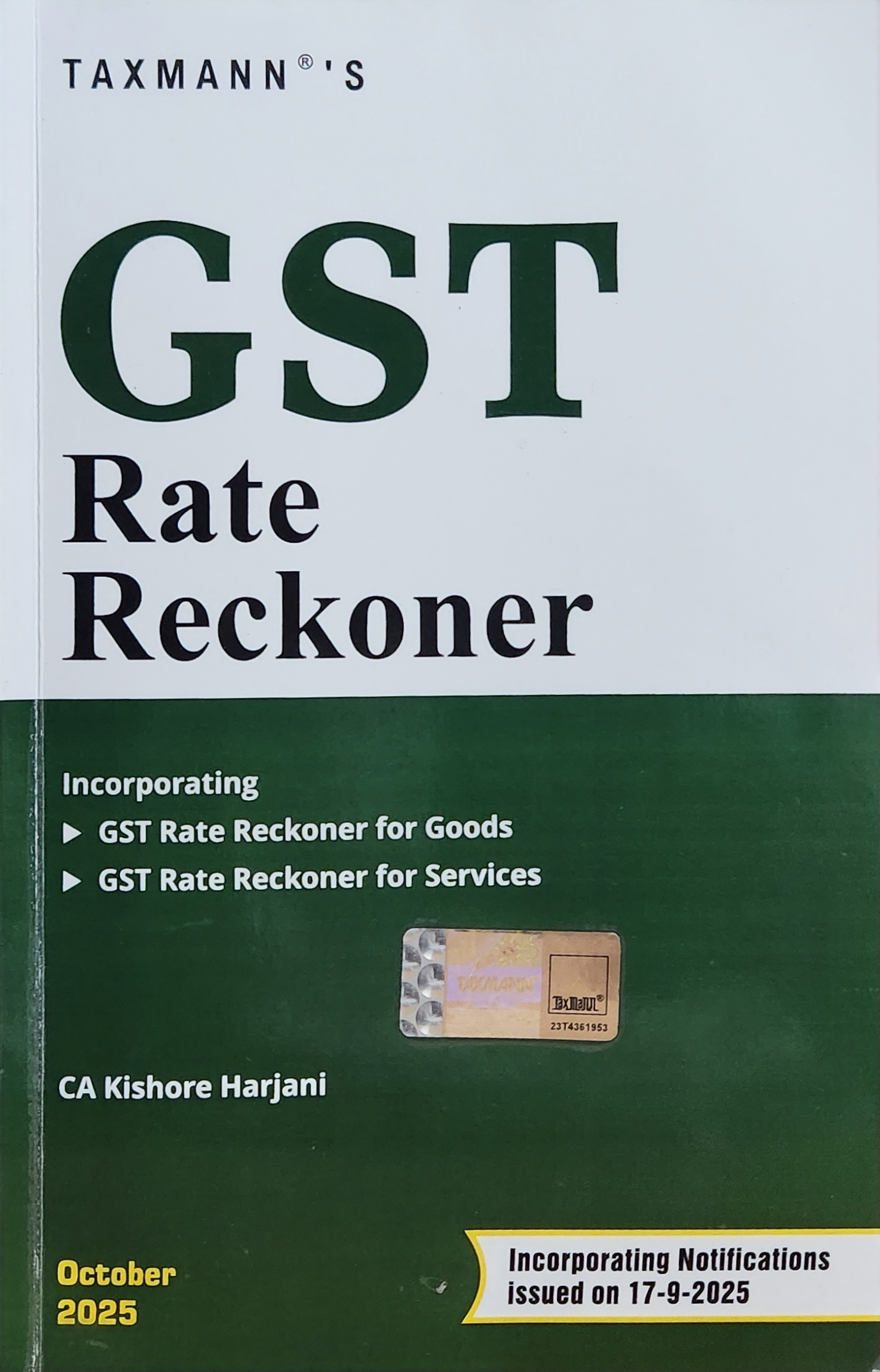
BUY GST RATE RECKONER | TAXMANN | 2025 | ISSUED ON 2025 | LATEST EDITIONS |
GST Rate Reckoner is a comprehensive and updated reference that consolidates the applicable GST rates on both goods and services into one accessible resource. Designed as a quick-reference handbook, it brings together the statutory rate structure (with the relevant HSN/SAC code), exemption notifications, clarifications, and amendments in a simplified, tabular format. With the October 2025 Edition, readers can access the most recent updates, including all notifications issued up to 17-09-2025, ensuring complete alignment with current law and practice. This reckoner reduces the complexity of GST classification and rate determination by providing an easy-to-navigate, sector-wise and service-wise listing. It is an indispensable tool for readers who require accuracy and speed in rate lookups during compliance, advisory, audits, and litigation.
This book is intended for the following audience:
- Indirect Tax Practitioners & Consultants who provide classification and compliance advice
- CFOs, Tax Managers & GST Officers managing tax incidence, pricing, and cost structures
- Accountants, Chartered Accountants, CMAs & CS Professionals engaged in return filing, reconciliations, and audits
- Lawyers & Litigation Counsels requiring authoritative rate references in disputes
- Businesses & Trade Associations that need sector-specific GST rate clarity
The Present Publication is the October 2025 Edition, incorporating Notifications issued on 17-09-2025. This book is authored by CA. Kishore Harjani with the following noteworthy features:
- [Dual Coverage] Separate, exhaustive reckoners for Goods and Services
- [Latest Notifications] Fully updated till 17-09-2025, capturing rate changes, exemptions, and clarifications
- [User-friendly Layout] Tabular presentation for quick GST rate retrieval
- [Classification Ready] HSN-wise listing for goods; Service codes with descriptions
- [Practical Utility] Simplifies GST classification for invoicing, ITC, compliance, and litigation
- [Trusted Reference] Draws on the legacy of Taxmann’s authoritative GST publications
The coverage of the book is as follows:
- GST Rate Reckoner for Goods
- HSN-wise listing of goods with applicable GST rates (0%, 5%, 12%, 18%, 28%)
- Exemption notifications, conditions, and clarifications
- Compensation Cess applicability
- Footnotes with cross-references to related notifications
- GST Rate Reckoner for Services
- Service code-wise GST rates (0%, 5%, 12%, 18%)
- Reverse charge notifications and clarifications
- Exemptions for education, healthcare, transport, and financial services
- Detailed notes on conditional exemptions
The structure of the book is as follows:
- The reckoner is presented in a dual-volume format:
- Volume 1 – GST Rates & Exemptions for Goods (HSN-wise, indexed)
- Volume 2 – GST Rates & Exemptions for Services (Service Code-wise, indexed)
- Each entry includes:
- Item/Service Description
- Relevant HSN/SAC Code
- Applicable GST Rate & Compensation Cess
- Related Exemption/Reverse Charge Notifications
- Notes & Clarifications
The Goods and Services Tax (GST) is an indirect tax introduced in India on 1 July 2017, replacing a range of pre-existing taxes like VAT, service tax, central excise duty, entertainment tax, and octroi. GST unified the country’s tax structure, simplifying the taxation of goods and services and eliminating the need for multiple taxes previously levied by both central and state governments.
GST is a comprehensive, multistage, and destination-based tax. It is considered comprehensive because it has replaced most indirect taxes, with a few exceptions for state taxes. The tax is multi-staged as it is levied at every stage of the production process, but is refunded to all parties involved, except the final consumer. Its destination-based nature means that the tax is collected at the point of consumption, rather than at the point of origin, marking a significant departure from previous tax systems.
The tax came into effect from 1 July 2017 through the implementation of the One Hundred and First Amendment to the Constitution of India by the Government of India. 1 July is celebrated as GST Day.[1]
ALSO REFER
Reviews
There are no reviews yet.