
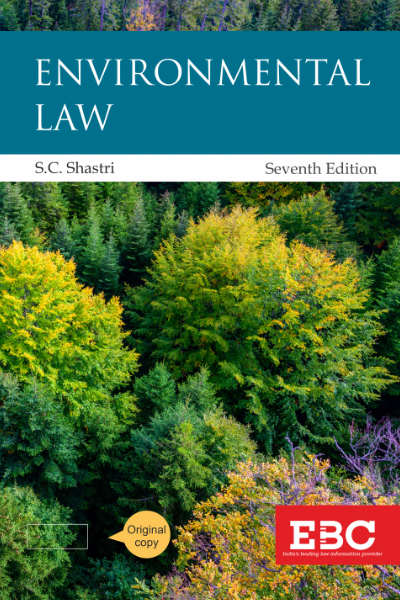
BUY ENVIRONMENTAL LAW S C SHASTRI | EASTERN BOOK COMPANY | BEST QUALITY | 7TH EDITION |
The present seventh edition of this greatly admired publication on Environmental Law by Prof. S.C. Shastri has been thoroughly revised and updated with all statutory and case law developments since the last edition.
The following are some of the highlights of this new edition:
A new write-up on “Environmental Rule of Law” (Chapter 4) and a new chapter titled “A Ray of Hope” (Chapter 16) for sustainable development.
Updated Act, Rules and Notifications, viz. Forest (Amendment) Act, 2017; Plastic Waste Management (Amendment) Rules, 2018; Prevention of Cruelty to Animals (Pet Shop) Rules, 2018; Coastal Regulation Zone Notification, 2019.
International environmental law covers the Paris Agreement, 2015 and the Glasgow Climate Change Conference, 2021 (COP 26).
The author has discussed the distinctive shift in the approach of the courts to achieve the goal of environmental justice i.e. from anthropocentric approach to ecocentric approach. The focus of the courts has shifted from humans to the protection and preservation of ecology or the present species of flora and fauna. The evolving concept of ‘corporate social responsibility’ in relation to environmental justice has also been provided due place in this work.
The book will prove to be immensely useful to students of LL.B. and LL.M., researchers, administrators, academicians, judges, advocates and NGOs. The book will definitely be a prized collection for any library.
Extract from the foreword
Dr. Satish Shastri by writing this book has done a great service to society. The book shows his immense interest, in-depth study and deep love for the subject and the law concerned.
– V.S. Dave, Former Judge, Rajasthan High Court
Environmental laws are laws that protect the environment.[1] The term “environmental law” encompasses treaties, statutes, regulations, conventions, and policies designed to protect the natural environment and manage the impact of human activities on ecosystems and natural resources, such as forests, minerals, or fisheries. It addresses issues such as pollution control, resource conservation, biodiversity protection, climate change mitigation, and sustainable development.
As part of both national and international legal frameworks, environmental law seeks to balance environmental preservation with economic and social needs, often through regulatory mechanisms, enforcement measures, and incentives for compliance.
The field emerged prominently in the mid-20th century as industrialization and environmental degradation spurred global awareness, culminating in landmark agreements like the 1972 Stockholm Conference and the 1992 Rio Declaration. Key principles include the precautionary principle, the polluter pays principle, and intergenerational equity. Modern environmental law intersects with human rights, international trade, and energy policy.
Internationally, treaties such as the Paris Agreement (2015), the Kyoto Protocol (1997), and the Convention on Biological Diversity (1992) establish cooperative frameworks for addressing transboundary issues. Nationally, laws like the UK’s Clean Air Act 1956 and the US Toxic Substances Control Act of 1976 establish regulations to limit pollution and manage chemical safety. Enforcement varies by jurisdiction, often involving governmental agencies, judicial systems, and international organizations. Environmental impact assessments are a common way to enforce environmental law.
Challenges in environmental law include reconciling economic growth with sustainability, determining adequate levels of compensation, and addressing enforcement gaps in international contexts. The field continues to evolve in response to emerging crises such as biodiversity loss, plastic pollution in oceans, and climate change.
History
Examples of laws designed to preserve the environment for its own sake or for human enjoyment are found throughout history. In the common law, the primary protection was found in the law of nuisance, but this only allowed for private actions for damages or injunctions if there was harm to land.
Thus, smells emanating from pigsties,[2] strict liability against dumping rubbish,[3] or damage from exploding dams.[4] Private enforcement, however, was limited and found to be woefully inadequate to deal with major environmental threats, particularly threats to common resources. During the “Great Stink” of 1858, the dumping of sewerage into the River Thames began to smell so ghastly in the summer heat that Parliament had to be evacuated.
Ironically, the Metropolitan Commission of Sewers Act 1848 had allowed the Metropolitan Commission for Sewers to close cesspits around the city in an attempt to “clean up” but this simply led people to pollute the river. In 19 days, Parliament passed a further Act to build the London sewerage system. London also suffered from terrible air pollution, and this culminated in the “Great Smog” of 1952, which in turn triggered its own legislative response: the Clean Air Act 1956. The basic regulatory structure was to set limits on emissions for households and businesses (particularly burning of coal) while an inspectorate would enforce compliance.
Also buy

Reviews
There are no reviews yet.