
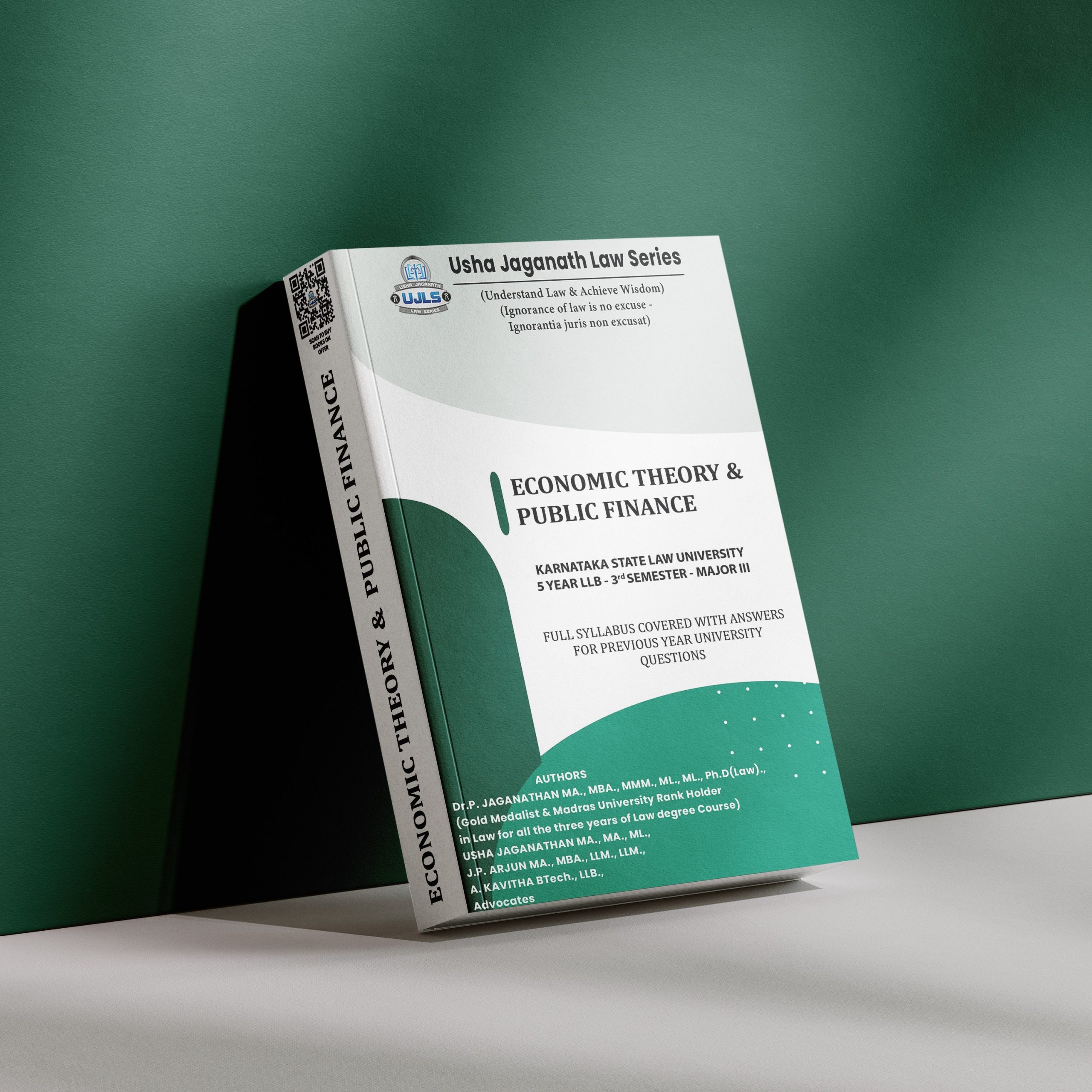
BUY ECONOMIC THEORY & PUBLIC FINANCE USHA | USHA JAGANATHAN LAW SERIES GUIDE | KARNATAKA STATE UNIVERSITY | BEST QUALITY | 1st EDITION |
Public finance refers to the monetary resources available to governments and also to the study of finance within government and role of the government in the economy.[1] Within academic settings, public finance is a widely studied subject in many branches of political science, political economy and public economics.
Research assesses the government revenue and government expenditure of the public authorities and the adjustment of one or the other to achieve desirable effects and avoid undesirable ones.[2] The purview of public finance is considered to be threefold, consisting of governmental effects on:[3]
- The efficient allocation of available resources;
- The distribution of income among citizens; and
- The stability of the economy.
American public policy advisor and economist Jonathan Gruber put forth a framework to assess the broad field of public finance in 2010:[4]
- When should the government intervene in the economy? To which there are two central motivations for government intervention, market failure and redistribution of income and wealth.[4]
- How might the government intervene? Once the decision is made to intervene the government must choose the specific tool or policy choice to carry out the intervention (for example public provision, taxation, or subsidization).[5]
- What is the effect of those interventions on economic outcomes? A question to assess the empirical direct and indirect effects of specific government intervention.[6]
- And finally, why do governments choose to intervene in the way that they do? This question is centrally concerned with the study of political economy, theorizing how governments make public policy.[7]
BUY ECONOMIC THEORY & PUBLIC FINANCE USHA | USHA JAGANATHAN LAW SERIES GUIDE | KARNATAKA STATE UNIVERSITY | BEST QUALITY | 1st EDITION |
Overview
One of the more traditional subfields of economics, public finance emphasizes the function and role of government in the economy. A region’s inhabitants established a formal or informal entity known as the government to carry out a variety of tasks, including providing for social requirements like education and healthcare as well as protecting the populace’s private property from outside threats.
The proper role of government provides a starting point for the analysis of public finance. In theory, under certain circumstances, private markets will allocate goods and services among individuals efficiently (in the sense that no waste occurs and that individual tastes are matching with the economy’s productive abilities). If private markets were able to provide efficient outcomes and if the distribution of income were socially acceptable, then there would be little or no scope for government. In many cases, however, conditions for private market efficiency are violated.
For example, if many people can enjoy the same good (the moment that good was produced and sold, it starts to give its utility to every one for free) at the same time (non-rival, non-excludable consumption), then private markets may supply too little of that good. National defense is one example of non-rival consumption, or of a public good.[8]
“Market failure” occurs when private markets do not allocate goods or services efficiently. The existence of market failure provides an efficiency-based rationale for collective or governmental provision of goods and services.[9] Externalities, public goods, informational advantages, strong economies of scale, and network effects can cause market failures. Public provision via a government or a voluntary association, however, is subject to other inefficiencies, termed “government failure.”
Under broad assumptions, government decisions about the efficient scope and level of activities can be efficiently separated from decisions about the design of taxation systems (Diamond-Mirrlees separation). In this view, public sector programs should be designed to maximize social benefits minus costs (cost-benefit analysis), and then revenues needed to pay for those expenditures should be raised through a taxation system that creates the fewest efficiency losses caused by distortion of economic activity as possible. In practice, government budgeting or public budgeting is substantially more complicated and often results in inefficient practices.
BUY ECONOMIC THEORY & PUBLIC FINANCE USHA | USHA JAGANATHAN LAW SERIES GUIDE | KARNATAKA STATE UNIVERSITY | BEST QUALITY | 1st EDITION |
Also Buy



Reviews
There are no reviews yet.