
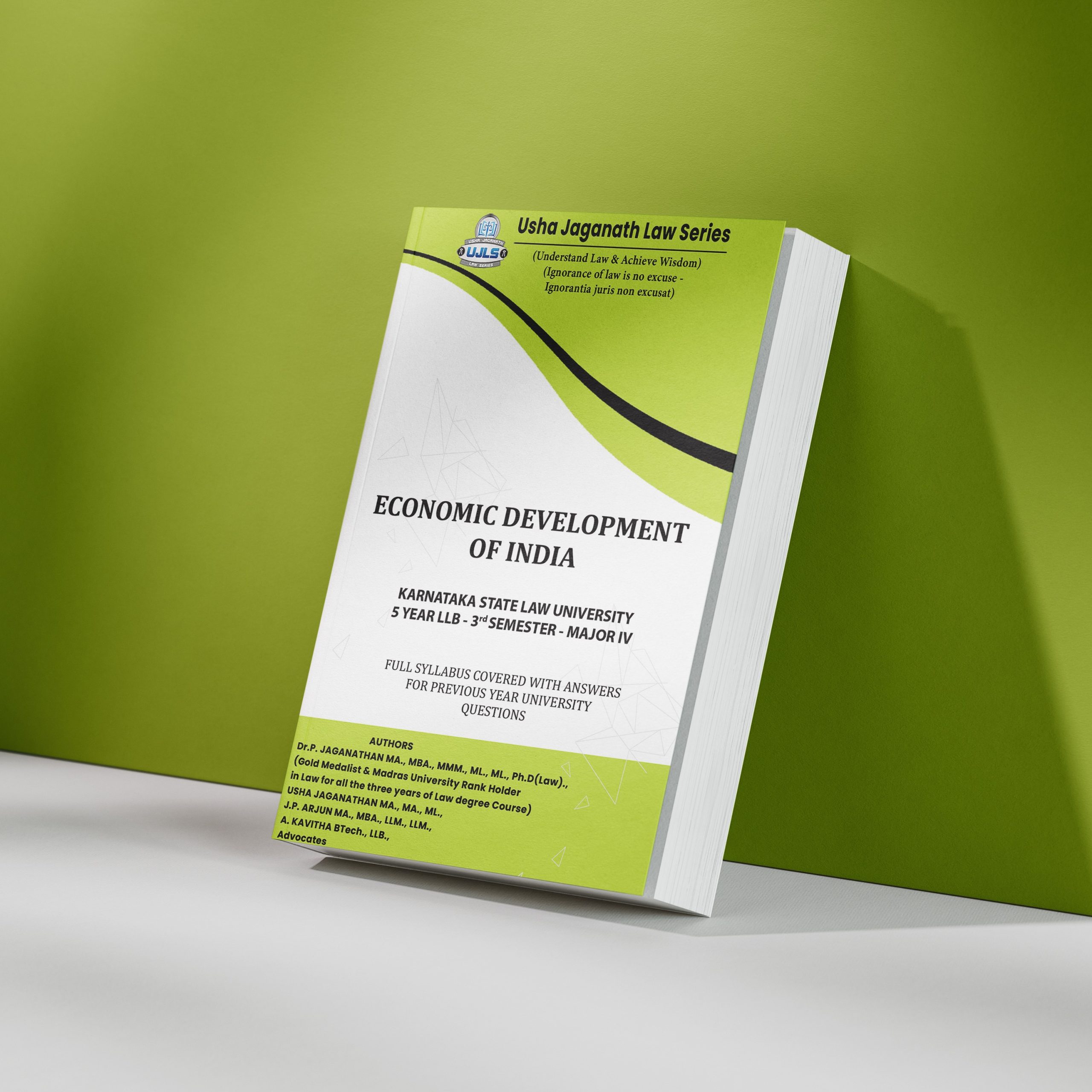
BUY ECONOMIC DEVELOPMENT OF INDIA USHA | USHA JAGANATHAN LAW SERIES GUIDE | ALL UNIVERSITIES | BEST QUALITY | 1st EDITION |
India, being one of the largest and most diverse countries in the world, has a complex and dynamic economy.Understanding the Indian economy requires a deep look at its historical background, current status, and future prospects.
This subject explores how India has evolved from an agrarian-based econo-my to a modern mixed economy with active participation from both public and private sectors. It also reflects the social, political, and global forces that influence economic development.
This syllabus on “Economic Development of India” is designed to help stu-dents develop a strong foundation in the core aspects of the Indian econo-my. The chapters are arranged thematically, beginning with the basic fea-tures of developing economies and then moving towards detailed sectors like agriculture, industry, banking, trade, and government finance.
Special attention is given to the challenges like unemployment, poverty, and low productivity, along with the solutions and reforms introduced over the years. The structure of this syllabus aims to give students both factual and analyt-ical knowledge.
It also includes an understanding of policies and strategies like land reforms, the Green Revolution, industrial policies, banking re-forms, and the LPG (Liberalisation, Privatisation, and Globalisation) model. By studying this syllabus, students can develop a clear perspective on how economic decisions are made, how economic planning has shaped the nation, and what steps are being taken to achieve inclusive and sustainable development.
The chapters in this book has been prepared in essay form in simple lan-guage so that students can easily understand and remember the subject matter. This book covers the entire syllabus of KSLU and also answers the previous year university question papers. We do hope that this book is tumultuously welcome by students as of our other books. Wishing our students credible success in the ensuing examination.
BUY ECONOMIC DEVELOPMENT OF INDIA USHA | USHA JAGANATHAN LAW SERIES GUIDE | Karnataka State University| BEST QUALITY | 1st EDITION |
The economic development in India followed socialist-inspired politicians for most of its independent history, including state-ownership of many sectors; India’s per capita income increased at only around 1% annualised rate in the three decades after its independence.[1]
Since the mid-1980s, India has slowly opened up its markets through economic liberalisation. After more fundamental reforms since 1991 and their renewal in the 2000s, India has progressed towards a free market economy.[1] The Indian economy is still performing well, with foreign investment and looser regulations driving significant growth in the country.[2]
In the late 2000s, India’s growth reached 7.5%, which will double the average income in a decade.[1] IMF says that if India pushed more fundamental market reforms, it could sustain the rate and even reach the government’s 2011 target of 10%.[1]
States have large responsibilities over their economies. The average annual growth rates (2007–12) for Gujarat (13.86%), Uttarakhand (13.66%), Bihar (10.15%) or Jharkhand (9.85%) were higher than for West Bengal (6.24%), Maharashtra (7.84%), Odisha (7.05%), Punjab (11.78%) or Assam (5.88%).[3] India is the fourth largest economy in the world by nominial basis and the third largest by purchasing power parity adjusted exchange rates (PPP). On per capita basis, it ranks 140th in the world or 129th by PPP.
The economic growth has been driven by the expansion of the services that have been growing consistently faster than other sectors.[citation needed] It is argued that the pattern of Indian development has been a specific one and that the country may be able to skip the intermediate industrialisation-led phase in the transformation of its economic structure. Serious concerns have been raised about the jobless nature of the economic growth.[4][5]
Favourable macroeconomic performance has been a necessary but not sufficient condition for the significant improvement in the human development indicators. Although the rate of poverty declined after economic reforms of 1991, the improvement in human development has been less than satisfactory. For instance, child malnutrition has continued to persist (46% in 2005–6).



Reviews
There are no reviews yet.