
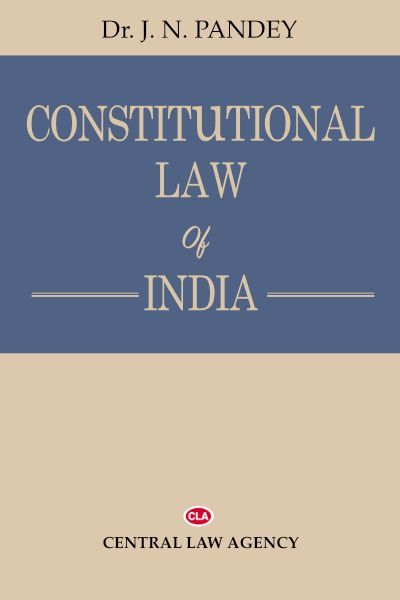
BUY CONSTITUIONAL LAW OF INDIA BY DR J N PANDEY | 62ND EDITION | CENTRAL LAW AGENCY | Best Text Book | 2025 |
Indian Constitution is transformative and one that is susceptible to change by virtue of legislations and judicial pronouncements. Tellingly, it becomes indispensable to understand the various aspects, amendments, dictums that have shaped its subject-matter and literature right from its inception in 1950.
Dr. J. N. Pandey’s Constitutional Law is considered as an authoritative work that provides, in a lucid yet vivid fashion, a meticulous discussion of the fundamental concepts of the sacrosanct Constitution. Running since 1969, the text serves as an apposite read to students of law, administrative officers, judicial and other general readers inquisitive to know about and research in the field of Constitutional Law of India.
Key Features of the book-
- Running for over 41 chapters, the books is written in a lucid yet vivid and detailed fashion, thereby, making it extremely student-friendly.
- Chronicles the vital and cardinal legal-historic narratives, right from the inception of the colonial era in 1600 to its present status and literature.
- Equipped with the landmark, latest, and other relevant judicial decisions that enhance the book’s contemporary relevance.
- Inclusive of all the legislative changes and amendments in the field of Constitutional Law.
BUY CONSTITUIONAL LAW OF INDIA BY DR J N PANDEY | 62ND EDITION | CENTRAL LAW AGENCY | Best Text Book | 2025 |
The Constitution of India is the supreme legal document of India, and the longest written national constitution in the world.[2][3][4][5] The document lays down the framework that demarcates fundamental political code, structure, procedures, powers, and duties of government institutions and sets out fundamental rights, directive principles, and the duties of citizens.
It espouses constitutional supremacy (not parliamentary supremacy found in the United Kingdom, since it was created by a constituent assembly rather than Parliament) and was adopted with a declaration in its preamble. Although the Indian Constitution does not contain a provision to limit the powers of the parliament to amend the constitution, the Supreme Court in Kesavananda Bharati v. State of Kerala held that there were certain features of the Indian constitution so integral to its functioning and existence that they could never be cut out of the constitution. This is known as the ‘Basic Structure’ Doctrine.
The Government of India Act 1935, mainly drafted by Samuel Hoare,[6] provided basis for the constitution of India. The constitution was adopted by the Constituent Assembly of India on 26 November 1949 and became effective on 26 January 1950.[7] It became the country’s fundamental governing document, and the Dominion of India became the Republic of India. To ensure constitutional autochthony, its framers repealed prior acts of the British parliament in Article 395.[8] India celebrates its constitution on 26 January as Republic Day.[9]
The constitution declares India a sovereign, socialist, secular,[10] and democratic republic, assures its citizens justice, equality, and liberty, and endeavours to promote fraternity.[11] The original 1950 constitution is preserved in a nitrogen-filled case at the Parliament Library Building in New Delhi.
BUY CONSTITUIONAL LAW OF INDIA BY DR J N PANDEY | 62ND EDITION | CENTRAL LAW AGENCY | Best Text Book | 2025 |
Background
In 1928, the All Parties Conference convened a committee in Lucknow to prepare the Constitution of India, which was known as the Nehru Report.
BUY CONSTITUIONAL LAW OF INDIA BY DR J N PANDEY | 62ND EDITION | CENTRAL LAW AGENCY | Best Text Book | 2025 |
Also
Reviews
There are no reviews yet.