
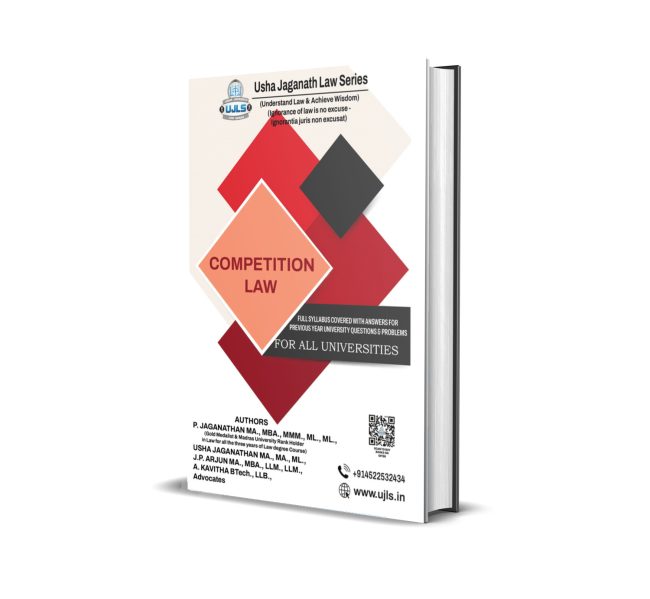
BUY COMPETETION LAW USHA | USHA JAGANATHAN LAW SERIES GUIDE | ALL UNIVERSITY | BEST QUALITY | 1st EDITION |
‘Competition’ means an activity or condition of striving to gain or win something by defeating or establishing superiority over others. It is an event or contest in which people take part in order to establish superiority or supremacy in a particular area.
Competition law is the field of law that promotes or seeks to maintain market competition by regulating anti-competitive conduct by companies.[1][2] Competition law is implemented through public and private enforcement.[3]
It is also known as antitrust law (or just antitrust[4]), anti-monopoly law,[1] and trade practices law; the act of pushing for antitrust measures or attacking monopolistic companies (known as trusts) is commonly known as trust busting.[5]
The history of competition law reaches back to the Roman Empire. The business practices of market traders, guilds and governments have always been subject to scrutiny, and sometimes severe sanctions. Since the 20th century, competition law has become global.[6]
The two largest and most influential systems of competition regulation are United States antitrust law and European Union competition law. National and regional competition authorities across the world have formed international support and enforcement networks.
Modern competition law has historically evolved on a national level to promote and maintain fair competition in markets principally within the territorial boundaries of nation-states.
National competition law usually does not cover activity beyond territorial borders unless it has significant effects at nation-state level.[2] Countries may allow for extraterritorial jurisdiction in competition cases based on so-called “effects doctrine”.[2][7] The protection of international competition is governed by international competition agreements. In 1945, during the negotiations preceding the adoption of the General Agreement on Tariffs and Trade (GATT) in 1947, limited international competition obligations were proposed within the Charter for an International Trade Organization.
BUY COMPETETION LAW USHA | USHA JAGANATHAN LAW SERIES GUIDE | ALL UNIVERSITY | BEST QUALITY | 1st EDITION |
These obligations were not included in GATT, but in 1994, with the conclusion of the Uruguay Round of GATT multilateral negotiations, the World Trade Organization (WTO) was created. The Agreement Establishing the WTO included a range of limited provisions on various cross-border competition issues on a sector specific basis.[8]
Elements
Competition law, or antitrust law, has three main elements:
- prohibiting agreements or practices that restrict free trading and competition between business. This includes in particular the repression of free trade caused by cartels.
- banning abusive behavior by a firm dominating a market, or anti-competitive practices that tend to lead to such a dominant position. Practices controlled in this way may include predatory pricing, tying, price gouging, and refusal to deal.
- supervising the mergers and acquisitions of large corporations, including some joint ventures. Transactions that are considered to threaten the competitive process can be prohibited altogether, or approved subject to “remedies” such as an obligation to divest part of the merged business or to offer licenses or access to facilities to enable other businesses to continue competing. BUY COMPETETION LAW USHA | USHA JAGANATHAN LAW SERIES GUIDE | ALL UNIVERSITY | BEST QUALITY | 1st EDITION |
-
Roman legislation
An early example was enacted during the Roman Republic around 50 BC.[11] To protect the grain trade, heavy fines were imposed on anyone directly, deliberately, and insidiously stopping supply ships.[12] Under Diocletian in 301 A.D., an edict imposed the death penalty for anyone violating a tariff system, for example by buying up, concealing, or contriving the scarcity of everyday goods.[12]
- More legislation came under the constitution of Zeno of 483 A.D., which can be traced into Florentine municipal laws of 1322 and 1325.[13] This provided for confiscation of property and banishment for any trade combination or joint action of monopolies private or granted by the Emperor. Zeno rescinded all previously granted exclusive rights.[14] Justinian I subsequently introduced legislation to pay officials to manage state monopolies.[14]
Also Buy,
Reviews
There are no reviews yet.