
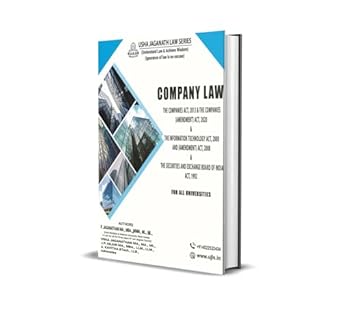
BUY COMPANY LAW USHA | USHA JAGANATHAN LAW SERIES GUIDE | ALL UNIVERSITY | BEST QUALITY | 1st EDITION |
Incorporated Companies Were The By-Products Of The Industrial Revolution In England In The 17Th Century. The Increase In Commercial Activities Necessitated Registered Companies To Have Statutory Rules And Legislations To Regulate Their Activities. In The Present Century, The Companies Growth All Over The Globe Is Phenomenal And Hence Requires In-depth Study Of The Company Rules.
No Commercial Man Is Perfect Without The Knowledge Of Company Law. This Book Enlightens All The Salient Provisions Of The Companies Act 1956 In A Simple And Coherent Language To Enable Even A Beginner To Fully Understand The Subject. The Legal Sections Of The Companies Act Have Been Presented In The Form Of Essays To Fulfill The Examination Needs. Short Notes And Solved Problems Given Separately At The End May Be Of Immense Help To The Students.
It Is Hoped That This Edition Will Receive Spontaneous Response From The Students And Others, As All Of Our Previous Editions.
BUY COMPANY LAW USHA | USHA JAGANATHAN LAW SERIES GUIDE | ALL UNIVERSITY | BEST QUALITY | 1st EDITION |
The 2013 Companies Act superseded the Companies Act of 1956, under whose provisions Indian corporations previously operated. In addition to the Companies Act, corporations are subject to other regulations administered by the Ministry of Corporate Affairs (MCA),[1] which has two branches: the Regional Director (RD) and the Registrar of Companies (ROC). At present, India has seven RDs and 22 ROCs.[when?] These two branches are also called in-house sources of adjudication.[citation needed]
Recent changes in Indian Company law
- Companies Act 2013
- Companies (1st Amendment) Act, 2015
- Companies (2nd Amendment) Act 2017
- Companies (3rd Amendment) Act 2019
- Companies (Amendment) Bill 2020
- Companies Fresh Start Scheme 2020
- Companies (Amendment) Ordinance 2018
- Companies (1st Amendment) Ordinance 2019
- Companies (2nd Amendment) Ordinance 2019
2015 amendment act
The Amendment Act (21 of 2015), passed to consolidate and amend the 2013 Companies Act, received assent from the President of India on 25 May 2015, and contained 23 sections. Official notice was published in the Gazette of India,[2] specifying 29 May as the date on which sections 1–13 and 15–23 of the act would come into force.[2]
Indian companies may be incorporated as either private or public. Under the original Act, both required certain amounts of paid-up capital; private companies required ₹100,000 (1 lakh) and public companies required ₹500,000 (5 lakh).
However, the Amendment Act abolished these limits, in order to increase the ease of doing business. It also permitted substitution of company seals with human signatures to sign documents.[citation needed]
2017 amendment act
The Ministry of Corporate Affairs promulgated a new Act on 26 January 2018, constituting 93 sections; of them, approximately 90 were announced by the Ministry through a series of eleven notifications (with the latest issued on 19 September 2018).
[needs update] Several modifications were made to the original Act by this amendment, mostly to improve its clarity and concision; among other changes, section 134 of the 2013 act was modified to require financial statements to carry the signatures of CEOs.[citation needed]
2019 amendment act
2020 amendment bill
A bill (88 of 2020) to amend the Companies Act was introduced in the Lok Sabha on 17 March, by Finance Minister Nirmala Sitharaman, received the President’s assent, and was announced on 28 September 2020.[3] It decriminalized minor offenses (eliminating imprisonment as a consequence for over 46 offenses defined by the Act), permitted direct listing of Indian companies in certain foreign jurisdictions, added a new chapter for producer companies, and created exemptions to several requirements.
These included setting up CSR committees and carry-forward mechanisms (previously set out in section 135 of the 2013 Act) and filing of NBFC resolutions with the Registry of Companies (previously set out in section 117 of the 2013 Act). It also provided the framework for exempting specific classes of companies and securities from the definition of “listed companies”.[3]
2020 Companies Fresh Start Scheme
Under this scheme introduced by the MCA, between 1 April 2020 and 30 September 2020, defaulting companies were provided a one-time opportunity to perform a “fresh start” and make their defaults good by filing belated documents (including annual returns and financial statements) without payment of any fee other than the normal statutory fee.
Companies were, furthermore, provided some immunity to prosecution.[clarification needed] Inactive companies were also permitted to obtain the status of a “dormant company” under section 455 of the Companies Act 2013.
BUY COMPANY LAW USHA | USHA JAGANATHAN LAW SERIES GUIDE | ALL UNIVERSITY | BEST QUALITY | 1st EDITION |
Also Buy,
CODE OF CIVIL PROCEDURE USHA


Reviews
There are no reviews yet.