
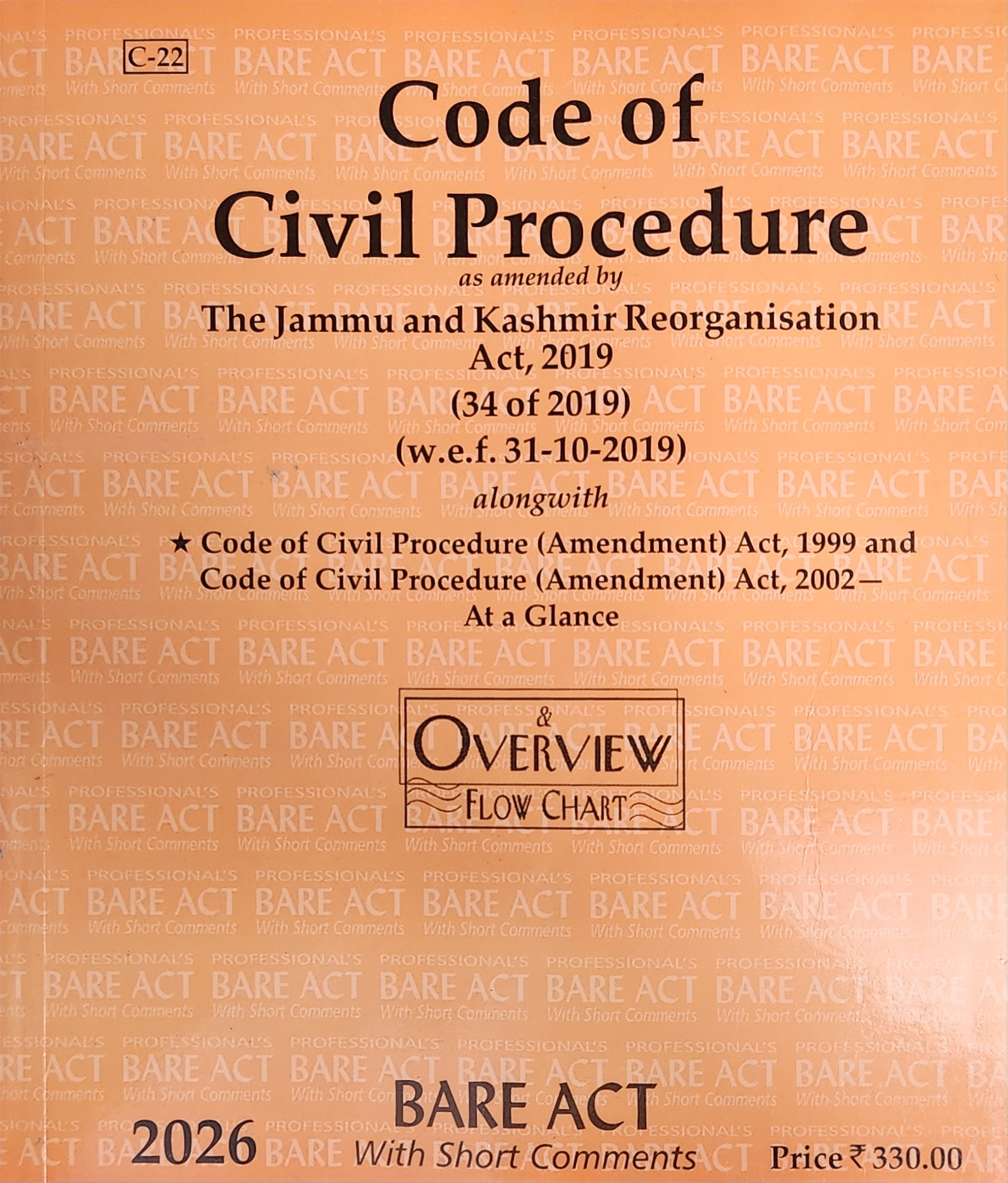
BUY CODE OF CIVIL PROCEDURE BARE ACT | PROFESSIONAL’S | BEST QUALITY | 2026 | WITH SHORT COMMENTS|
The Code of Civil Procedure, 1908 is a procedural law related to the administration of civil proceedings in India.
The Code is divided into two parts: the first part contains 158 sections and the second part contains the First Schedule, which has 51 Orders and Rules. The sections provide provisions related to general principles of jurisdiction whereas the Orders and Rules prescribe procedures and method that govern civil proceedings in India.
History
To give uniformity to Civil Procedure, the Legislative Council of India enacted Code of Civil Procedure, 1858, which received the assent of Governor-General on 23 March 1859. The Code however, was not applicable to the Supreme Court in the Presidency Towns and to the Presidency Small Cause Courts.
It did not meet the challenges and was replaced by Code of Civil Procedure Code, 1877. But still it did not fulfill the requirements of time and large amendments were introduced. In 1882, the Code of Civil Procedure, 1882 was introduced. With passing of time it was felt that it needed flexibility for timeliness and effectiveness.
To meet these problems Code of Civil Procedure, 1908 was enacted. Though it has been amended a number of times, it has withstood the test of time.
BUY CODE OF CIVIL PROCEDURE BARE ACT | PROFESSIONAL’S | BEST QUALITY | 2026 | WITH SHORT COMMENTS|
Amendments
The Code of Civil Procedure was substantially amended in the year 2002. The main purpose of the Amendment to the code was to ensure speedy disposal of civil cases governed under the Act.
BUY CODE OF CIVIL PROCEDURE BARE ACT | PROFESSIONAL’S | BEST QUALITY | 2026 | WITH SHORT COMMENTS|
Civil Procedure Code (Amendment) Act 2015
Keeping in view the establishment of Commercial Court and the provisions thereof, Civil Procedure Code (Amendment) Act, 2016 was enacted. These provisions are applicable to commercial disputes of specified value. The act clarified that the provisions of the Civil Procedure Code as amended by the Act would have an overriding effect over any rules of the High Court or of the amendments made by the state government concerned.[3]
The Code of Civil Procedure, 1908 was further amended in the year 2018.
The Code of Civil Procedure, 1908 is a bare act that consolidates and amends the laws for civil courts in India. It outlines the procedure for civil lawsuits from initiation to conclusion. The act consists of 158 sections and 51 orders, which are further divided into 11 parts, with sections covering policy and orders and rules detailing the procedural steps. It came into force on January 1, 1909, and applies to all of India except for certain areas like the State of Nagaland and tribal areas.
- Purpose: To provide a clear, written procedure for civil courts to handle cases efficiently, from the presentation of a suit to the execution of a decree.
- Structure: Comprises 158 sections and 51 orders, with sections handling substantive provisions and orders/rules detailing the procedural steps.
- Scope: Applies to the whole of India, with specific exclusions.
- Definitions: Includes crucial definitions for terms like “decree” (a formal expression of an adjudication that conclusively determines the rights of parties) and “judgment-debtor” (any person against whom a decree has been passed).
- Application: The Code governs the procedure for civil suits in India.
BUY CODE OF CIVIL PROCEDURE BARE ACT | PROFESSIONAL’S | BEST QUALITY | 2026 | WITH SHORT COMMENTS|
Also Buy,

Reviews
There are no reviews yet.