
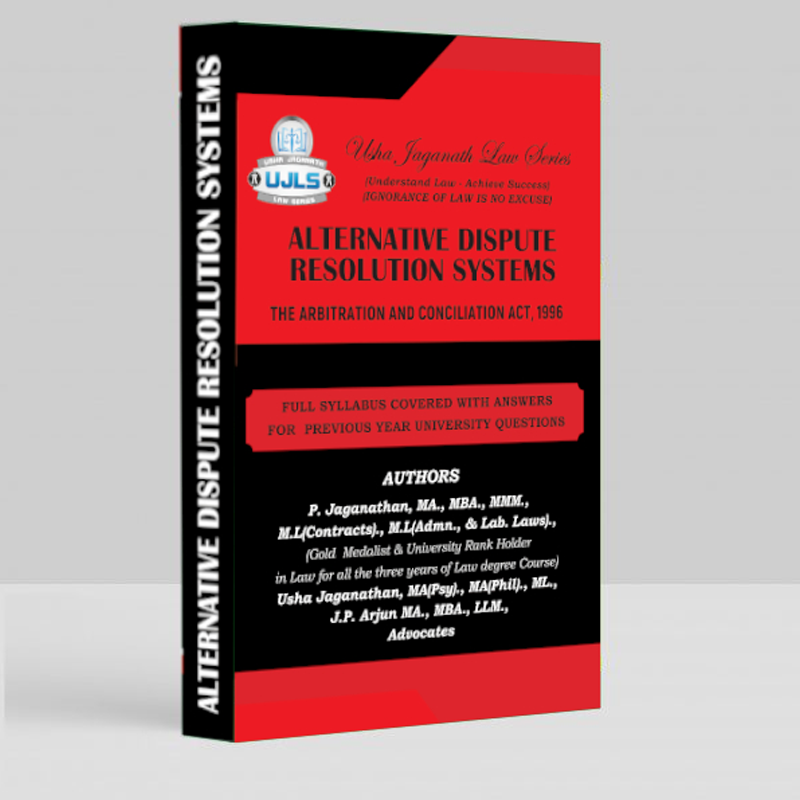
BUY ALTERNATIVE DISPUTES RESOLUTION ADR USHA GUIDE | USHA JAGANATHAN LAW SERIES | ALL UNIVERSITY | BEST QUALITY | 3RD EDITION |
The Concept Of Globalisation And The World – A Global Village Has Necessitated The Indian Parliament To Repeal The Outdated Arbitration Act, 1940 And Substitute It With A More Dynamic And Vibrant Act Namely The Arbitration And Conciliation Act, 1996.
ALTERNATIVE DISPUTES RESOLUTION ADR USHA GUIDE
Alternative dispute resolution (ADR), or external dispute resolution (EDR), typically denotes a wide range of dispute resolution processes and techniques that parties can use to settle disputes with the help of a third party.[1]
They are used for disagreeing parties who cannot come to an agreement short of litigation.
However, ADR is also increasingly being adopted as a tool to help settle disputes within the court system.[2][3]
Despite historic resistance to ADR by many popular parties and their advocates, ADR has gained widespread acceptance among both the general public and the legal profession in recent years.[
In 2008, some courts required some parties to resort to ADR of some type like mediation, before permitting the parties’ cases to be tried (the European Mediation Directive (2008) expressly contemplates so-called “compulsory” mediation. This means that attendance is compulsory, not that settlement must be reached through mediation).[4]
Additionally, parties to merger and acquisition transactions are increasingly turning to ADR to resolve post-acquisition disputes.[5] In England and Wales, ADR is now more commonly referred to as ‘NCDR’ (Non Court Dispute Resolution), in an effort to promote this as the normal (rather than alternative) way to resolve disputes.
A 2023 judgment of the Court of Appeal called Churchill v Merthyr[6] confirmed that in the right case the Court can order (i) the parties to engage in NCDR and / or (ii) stay the proceedings to allow for NCDR to take place.
This overturns the previous orthodoxy (the 2004 Court of Appeal decision of Halsey v. Milton Keynes General NHS Trust[7]) which was that unwilling parties could not be obliged to participate in NCDR.
The rising popularity of ADR can be explained by the increasing caseload of traditional courts, the perception that ADR imposes fewer costs than litigation, a preference for confidentiality, and the desire of some parties to have greater control over the selection of the individual or individuals who will decide their dispute.[8]
Some of the senior judiciary in certain jurisdictions (of which England and Wales is one) are strongly in favour of this use of mediation and other NCDR processes to settle disputes.[9][10] Since the 1990s many American courts have also increasingly advocated for the use of ADR to settle disputes.[11]
ADR has historically been divided between methods of resolving disputes outside of official judicial mechanisms and informal methods attached to official judicial mechanisms. Regardless of whether they are part of an overarching proceeding, the mechanisms are generally similar.
There are four general classes of ADR: negotiation, mediation, collaborative law, and arbitration. In some contexts, such as in the settlement of investment disputes, arbitration is not considered as a form of ADR, since it is the principal means of settling these disputes.[15] Some academics include conciliation as a fifth category, but others include this within the definition of mediation.
ALTERNATIVE DISPUTES RESOLUTION ADR USHA GUIDE
Also buy
BNS Usha Guide – Bharathiya Nyaya Sanhita ( Criminal Law – 1) .
Thank you.

![Contract II (Tamil) [ஒப்பந்தம் II (தமிழ்)]](https://karthicklawagency.com/wp-content/uploads/2023/07/Contract-II-01-300x300.png)
Reviews
There are no reviews yet.